

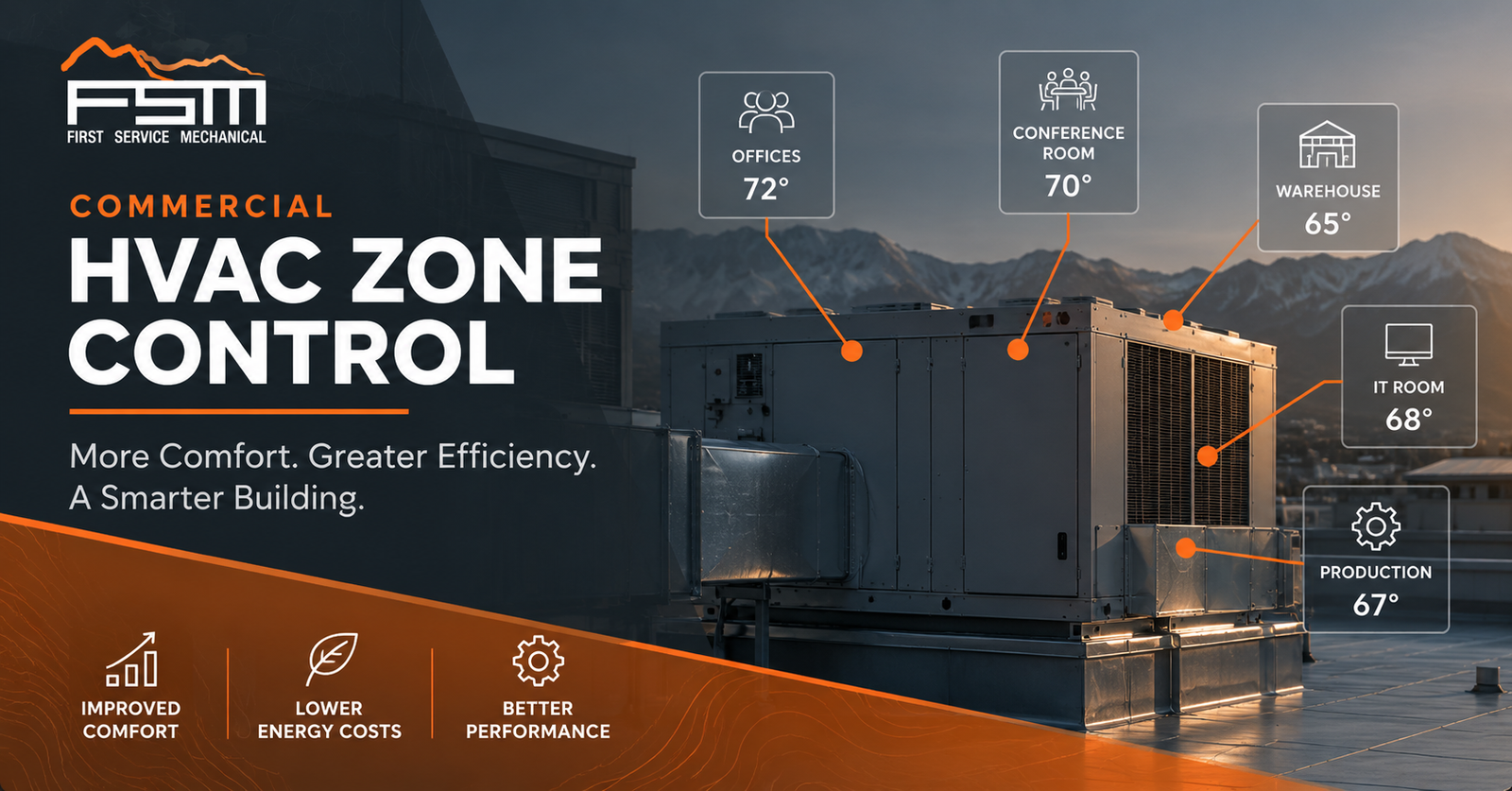
Keeping every area of a commercial building comfortable can be challenging. A conference room filled with people may need more cooling than a nearby office. A warehouse may have completely different temperature requirements than an attached administrative space. Areas with large windows can also experience greater heat gain than interior rooms.
Trying to maintain all of these spaces at the same temperature with a single thermostat can lead to hot and cold spots, frequent comfort complaints, and unnecessary energy consumption.
HVAC zone control gives facility managers greater control over how heating and cooling are delivered throughout a building. By dividing a facility into separate zones, the HVAC system can respond more closely to the actual needs of different spaces.
For commercial and industrial facilities, properly designed zoning can improve comfort, reduce energy waste, and help the entire HVAC system operate more efficiently.
What Is HVAC Zone Control?
HVAC zone control divides a building into individual areas, or zones, that can be managed according to their specific heating and cooling requirements.
Instead of relying on one temperature reading for an entire facility, a zoned system uses thermostats or sensors to monitor conditions in different areas. HVAC controls then determine how the system should respond.
Depending on the building and HVAC configuration, a zone control system may use components such as:
- Temperature sensors
- Thermostats
- Motorized dampers
- Actuators
- Variable air volume (VAV) boxes
- HVAC controllers
- Building automation systems
- Rooftop units, air handlers, boilers, or chillers
These components work together to direct heating and cooling where it is needed.
Zone control is one part of a larger commercial control strategy. As discussed in our guide to commercial HVAC controls, properly configured controls can improve comfort and efficiency while reducing unnecessary equipment operation.
Why Do Commercial Buildings Need HVAC Zones?
Commercial facilities rarely have identical heating and cooling requirements throughout the entire building.
Consider a large office. An interior conference room might quickly become warm when 15 people gather for a meeting, while a private office along an exterior wall may need more heat during the winter. A server or equipment room may require cooling even when nearby spaces do not.
Other factors that affect HVAC demand include:
- Sun exposure and building orientation
- Number of occupants
- Operating hours
- Lighting and equipment
- Ceiling height
- Building layout
- Exterior doors and loading areas
- Manufacturing processes
- Changes in how spaces are used
Without effective zoning, an HVAC system may over-condition one area while another remains uncomfortable.
This can lead facility teams to repeatedly adjust thermostats without addressing the underlying problem.
How Does Commercial HVAC Zone Control Work?
A typical zone control system continuously monitors temperatures in different areas of the building.
When a zone requires heating or cooling, its thermostat or sensor communicates that demand to the HVAC control system. The system can then adjust airflow, equipment operation, dampers, or other components to respond to the zone.
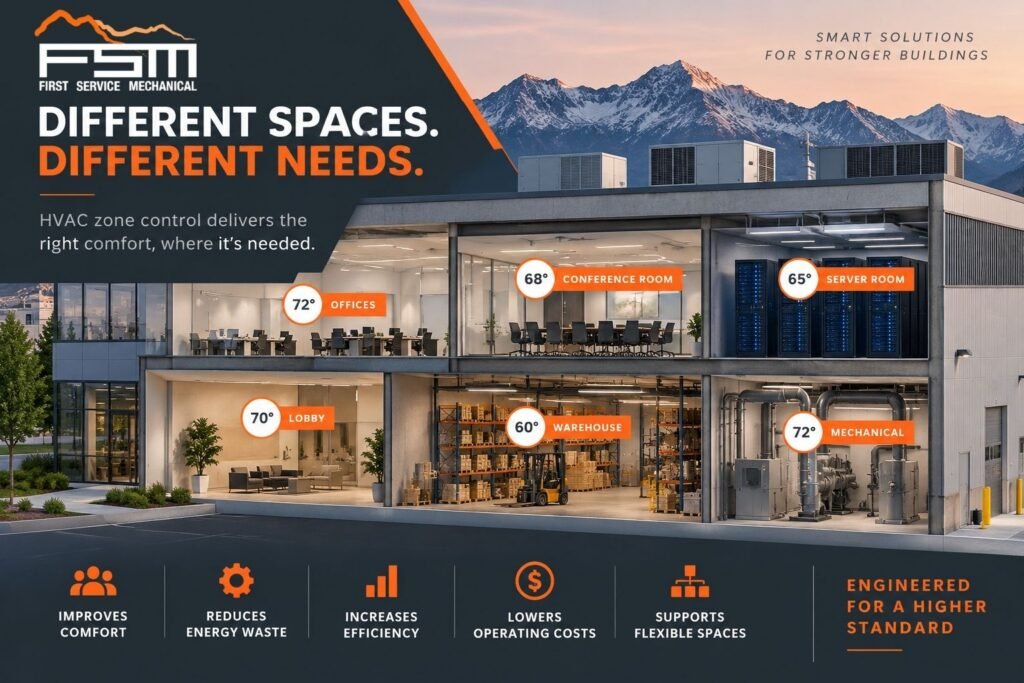
For example, a building may have separate zones for its lobby, offices, conference rooms, warehouse, and administrative areas. During periods of high occupancy, conference rooms may require additional cooling. Later in the day, those rooms may require very little conditioning while employees remain in other parts of the facility.
Modern HVAC controls can help the building respond to these changing conditions rather than operating every space identically throughout the day.
5 Benefits of HVAC Zone Control
1. More Consistent Occupant Comfort
One of the biggest advantages of HVAC zone control is the ability to address different comfort requirements throughout a facility.
Hot and cold spots are common in commercial buildings, especially when spaces have different occupancy levels, layouts, equipment loads, or sun exposure.
Zoning provides greater control over individual areas so the HVAC system can respond more accurately to those differences.
That can mean fewer thermostat adjustments and fewer complaints from employees, tenants, customers, or other building occupants.
2. Reduced Energy Waste
Heating or cooling an area that does not need it wastes energy.
For example, a large training room may only be occupied several times per week. Providing the same level of conditioning to that room as a constantly occupied workspace can increase unnecessary HVAC runtime.
Zone control can allow HVAC operation to better match occupancy and demand.
Combined with properly configured schedules and building controls, this approach can support a broader HVAC efficiency optimization strategy designed to reduce unnecessary energy consumption and operating costs.
3. Greater Flexibility as Buildings Change
Commercial buildings rarely operate exactly as they did when they were first constructed.
Companies expand. Offices are rearranged. Walls are added or removed. New equipment is installed. Departments move, and areas originally designed for one purpose are converted to something entirely different.
The HVAC system needs to keep up.
When building use changes significantly, existing zoning and control strategies may no longer match actual heating and cooling demand. Evaluating HVAC zones as part of a renovation or facility change can help ensure the mechanical system continues supporting the way the building is currently used.
An HVAC operational assessment can help facility managers identify these types of performance gaps before they turn into larger comfort or operating-cost problems.
4. Better Overall HVAC Performance
HVAC zoning does not operate independently from the rest of the mechanical system.
Controls, sensors, dampers, ductwork, fans, and HVAC equipment all need to work together.
If one component is not functioning correctly, zone performance can suffer. A thermostat may call for cooling, for example, but improper airflow could prevent enough conditioned air from reaching the space.
That is why zoning issues sometimes require looking beyond the thermostat.
Proper commercial air balancing can help verify that the correct amount of conditioned air is actually reaching each area. When controls and airflow are working together properly, the HVAC system can respond much more effectively to individual zone demands.
5. Less Unnecessary Strain on HVAC Equipment
When HVAC systems continually try to compensate for poorly controlled spaces, equipment may operate longer or cycle more frequently than necessary.
Over time, that additional runtime can increase wear on fans, motors, compressors, pumps, and other components.
A properly operating zone control strategy helps equipment respond more closely to actual building demand.
Regular preventive HVAC maintenance is also important because sensors, dampers, actuators, controls, and mechanical equipment need to remain properly maintained for the zoning strategy to work as intended.
HVAC Zone Control vs. Air Balancing
HVAC zone control and air balancing are closely connected, but they solve different problems.
Zone control determines where and when heating or cooling is needed.
Air balancing helps ensure the proper amount of airflow reaches those areas.
A building could have sophisticated zone controls but still experience comfort problems if airflow is restricted or improperly distributed. Likewise, perfectly balanced airflow cannot compensate for controls that are incorrectly programmed or responding to inaccurate sensors.
For facilities experiencing persistent hot and cold spots, evaluating both zoning and airflow can provide a more complete picture of what is happening.
Signs Your HVAC Zones May Need Attention
Zone control problems do not always result in a complete HVAC failure. Instead, they often appear as ongoing performance issues.
Common warning signs include persistent hot or cold areas, frequent thermostat adjustments, zones that struggle to reach their setpoints, equipment operating when spaces are unoccupied, rising energy costs, or recurring occupant complaints.
Changes to the building can also create zoning problems.
Renovations, new walls, occupancy changes, equipment upgrades, and modified operating schedules can alter heating and cooling requirements. Even a system that originally performed well may need adjustments as the facility evolves.
Commercial HVAC retro-commissioning can help identify control, scheduling, airflow, and sensor issues that have developed over time.
Can HVAC Zone Control Be Added to an Existing Building?
In many cases, zoning and control improvements can be made without replacing the entire HVAC system.
The right approach depends on the building’s existing equipment, ductwork, controls, layout, and operational needs.
Some facilities may benefit from updated sensors or control programming. Others may require damper modifications, air balancing, new control components, or a larger HVAC retrofit.
A professional evaluation is important because adding controls alone will not solve every comfort problem. The underlying issue could involve airflow, equipment capacity, ductwork, sensors, controls, or several factors working together.
Improve HVAC Zone Control in Your Commercial Facility
A commercial building should not have to treat every space exactly the same.
Effective HVAC zone control allows heating and cooling to better match the needs of individual areas, helping facilities maintain consistent comfort while reducing unnecessary energy consumption and equipment operation.
First Service Mechanical provides comprehensive commercial HVAC services throughout Utah and the surrounding region, including controls, air balancing, HVAC retrofits, preventive maintenance, assessments, and efficiency optimization.
If your facility is dealing with persistent hot and cold spots, frequent comfort complaints, or HVAC controls that no longer match how your building operates, contact First Service Mechanical to have your system evaluated and identify practical opportunities to improve performance.

Leave a Reply