

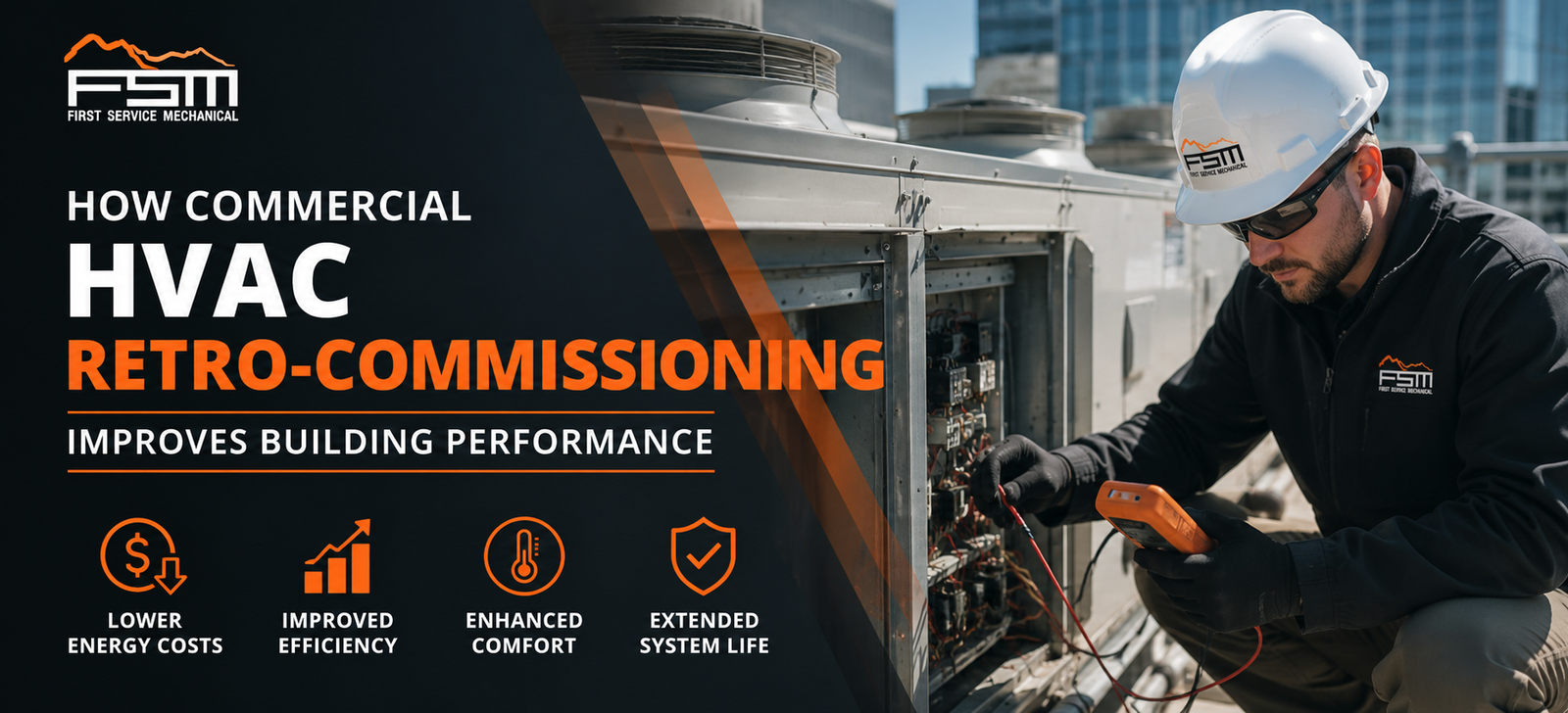
Commercial buildings are designed to operate efficiently, but that performance naturally declines over time. Equipment ages, occupancy patterns change, controls are adjusted, and minor issues gradually add up. The result is higher utility bills, inconsistent comfort, and HVAC systems that work harder than they should.
Fortunately, improving building performance doesn’t always require replacing expensive equipment. Commercial HVAC retro-commissioning is a proven process that identifies hidden inefficiencies and restores your existing HVAC system to optimal operation. For many facility managers and building owners, it’s one of the most cost-effective ways to reduce energy consumption, improve occupant comfort, and extend equipment life.
At First Service Mechanical, we help commercial facilities throughout Utah maximize the performance of their HVAC systems through expert diagnostics, controls optimization, and building automation solutions.
What Is Commercial HVAC Retro-Commissioning?
Commercial HVAC retro-commissioning (often abbreviated as RCx) is a systematic process used to evaluate, test, and optimize an existing building’s HVAC systems. The goal is to ensure every component operates as originally intended while adapting the system to current building needs.
Unlike installing new equipment, retro-commissioning focuses on improving the performance of the systems already in place.
Commissioning vs. Recommissioning vs. Retro-Commissioning
Although the terms sound similar, they serve different purposes:
- Commissioning is performed when a building is newly constructed to verify that systems operate correctly before occupancy.
- Recommissioning involves repeating the commissioning process on a building that has previously been commissioned.
- Retro-commissioning applies to existing buildings that were never formally commissioned or whose performance has declined over time.
For many commercial buildings that are several years old, retro-commissioning uncovers operational issues that have quietly developed over years of daily use.
Signs Your Building Could Benefit from Retro-Commissioning
Many facility managers assume rising operating costs are simply part of owning an aging building. In reality, they often indicate correctable HVAC inefficiencies.
Some common warning signs include:
Rising Utility Bills
If energy costs continue climbing without significant changes in occupancy or weather, your HVAC system may be wasting energy through improper controls, airflow issues, or equipment operating outside its intended parameters.
Uneven Temperatures
Hot and cold spots throughout a building often indicate balancing problems, malfunctioning dampers, or control issues that can frequently be corrected without replacing equipment.
Frequent Occupant Comfort Complaints
Comfort complaints reduce employee satisfaction and productivity while increasing maintenance requests. Retro-commissioning helps identify the root cause rather than simply treating symptoms.
Increasing Service Calls
If technicians are regularly addressing recurring HVAC issues, there may be underlying operational problems affecting multiple system components.
Equipment Runs Longer Than Necessary
Poor scheduling, outdated programming, or faulty sensors may cause HVAC equipment to operate during unoccupied hours, increasing both energy consumption and equipment wear.
What Does the Retro-Commissioning Process Include?
Every commercial facility is different, but a comprehensive retro-commissioning project typically includes several important steps.
System Testing
Technicians evaluate the operation of air handlers, rooftop units, chillers, boilers, pumps, and other HVAC equipment to verify they perform according to design specifications.
Controls Verification
Building controls are reviewed to ensure equipment starts, stops, and modulates correctly. Small programming errors can significantly impact energy usage over time.
Airflow Balancing
Proper airflow is critical for occupant comfort and equipment efficiency. Air distribution is tested and adjusted to ensure each space receives appropriate heating and cooling.
Sensor Calibration
Temperature, humidity, pressure, and airflow sensors provide the data that building automation systems rely on. If sensors become inaccurate, the entire HVAC system can respond incorrectly.
Scheduling Optimization
Many buildings continue operating HVAC equipment long after occupants have left for the day. Updating schedules to match actual occupancy can immediately reduce operating costs.
Building Automation System Review
Building Automation Systems (BAS) collect valuable operational data. Reviewing trends, alarms, sequences of operation, and equipment performance helps identify opportunities for further optimization.
Benefits of Commercial HVAC Retro-Commissioning
Retro-commissioning delivers measurable improvements across nearly every aspect of building performance.
Lower Energy Costs
One of the biggest advantages is improved energy efficiency. Correcting operational issues often reduces energy consumption without requiring major capital investments.
Even relatively small adjustments to controls, scheduling, or airflow can generate substantial utility savings over the life of the building.
Extended Equipment Lifespan
HVAC equipment that cycles correctly and operates under proper conditions experiences less wear and tear. This helps postpone costly replacements while improving overall system reliability.
Improved Indoor Comfort
Stable indoor temperatures and proper ventilation create a more comfortable environment for employees, customers, tenants, patients, and visitors.
Increased Occupant Productivity
Comfort directly affects concentration, productivity, and satisfaction. Employees who aren’t distracted by temperature fluctuations can focus more effectively on their work.
Reduced Maintenance Costs
Correcting underlying operational problems often decreases emergency repairs, minimizes equipment failures, and reduces routine maintenance expenses.
How Building Automation Supports Retro-Commissioning
Building Automation Systems play a critical role in maintaining long-term HVAC performance.
Rather than simply correcting today’s issues, modern building automation allows facility managers to continuously monitor system performance and quickly identify developing problems.
A properly configured BAS can:
- Continuously monitor HVAC equipment performance
- Automatically adjust system operation based on occupancy
- Track energy usage trends
- Alert maintenance staff to developing issues
- Optimize equipment sequencing
- Reduce unnecessary runtime
At First Service Mechanical, our building automation expertise helps clients maintain the improvements achieved through retro-commissioning while providing valuable operational insight for years to come.
When Should You Consider Retro-Commissioning?
Although every building is unique, several situations make retro-commissioning particularly valuable.
Buildings More Than 5 to 10 Years Old
As buildings age, operational drift naturally occurs. Equipment settings change, repairs alter performance, and occupancy patterns evolve.
After Renovations
Building remodels often change airflow requirements, occupancy, and space usage. Retro-commissioning helps ensure HVAC systems adapt to these changes.
Following Occupancy Changes
If departments relocate, office layouts change, or operating schedules shift, HVAC systems should be evaluated to ensure they continue serving the building efficiently.
Before Major Capital Investments
Many owners assume aging HVAC equipment must be replaced when performance declines. Retro-commissioning often restores significant efficiency at a fraction of replacement costs, helping determine whether new equipment is truly necessary.
Partner with First Service Mechanical
Commercial HVAC retro-commissioning is one of the smartest investments building owners can make to improve efficiency, reduce operating costs, and maximize the value of existing equipment. By identifying hidden inefficiencies and optimizing system performance, retro-commissioning delivers measurable results without the expense of a complete HVAC replacement.
If your building is experiencing rising utility bills, inconsistent comfort, or increasing maintenance costs, First Service Mechanical can help. Our experienced team provides comprehensive HVAC services, building automation solutions, controls expertise, and system optimization to keep your facility operating at peak performance.
Contact First Service Mechanical today to schedule a commercial HVAC performance assessment and discover how retro-commissioning can improve your building’s efficiency before investing in costly equipment replacements.

Leave a Reply