

Commercial HVAC systems represent a significant investment for any facility. As equipment ages and building needs change, facility managers often face an important question: Should we continue repairing the existing system, replace it entirely, or find another way to improve its performance?
In many cases, there is another option worth considering: a commercial HVAC retrofit.
HVAC retrofits allow businesses to upgrade specific components or capabilities of an existing mechanical system without replacing everything at once. Depending on the facility and condition of the equipment, a retrofit can improve efficiency, reliability, comfort, and system performance while helping an organization manage capital expenses more strategically.
Understanding when a retrofit makes sense can help facility managers get more value from existing equipment while planning for future HVAC needs.
What Is a Commercial HVAC Retrofit?
A commercial HVAC retrofit involves modifying or upgrading an existing HVAC system with new equipment, components, or technology.
Unlike a full system replacement, which removes existing equipment and installs an entirely new system, retrofitting focuses on improving portions of the mechanical system that can continue providing value.
The scope of a retrofit varies considerably from one building to another. It may involve upgrading controls, replacing inefficient components, modifying ductwork, improving airflow, installing new motors or drives, or integrating newer technology with existing equipment.
The goal is to address specific performance issues while preserving equipment and infrastructure that remain useful.
HVAC Retrofit vs. Retro-Commissioning
Although the terms sound similar, an HVAC retrofit and retro-commissioning are different processes.
Retro-commissioning evaluates an existing building’s HVAC operation to identify problems with controls, schedules, sensors, airflow, and other operating conditions. The objective is generally to restore or optimize how existing systems operate.
A retrofit goes a step further by physically upgrading or modifying parts of the HVAC system.
For example, correcting an improperly programmed equipment schedule may be part of retro-commissioning. Installing new controls or replacing an outdated component would be considered a retrofit.
Both approaches can play an important role in improving an existing commercial facility.
Why Retrofit an Existing Commercial HVAC System?
Replacing an entire HVAC system isn’t always necessary when performance begins declining.
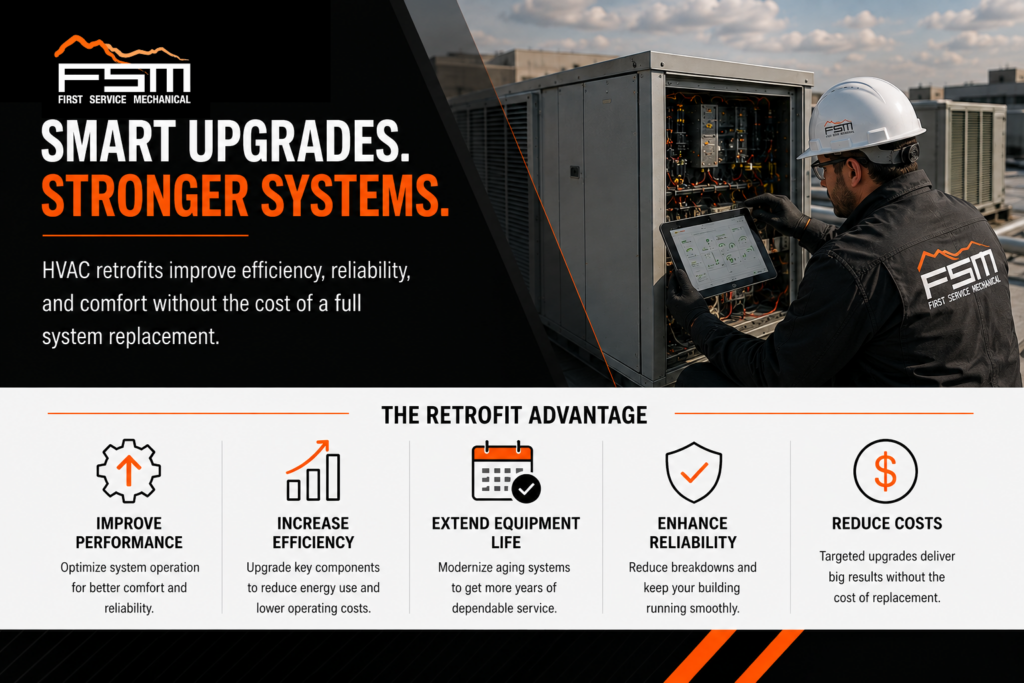
Some systems still have years of useful service remaining but contain individual components that are outdated, inefficient, or no longer appropriate for the building’s needs. In these situations, targeted upgrades can address the weakest points without requiring a complete replacement.
Retrofits can also help businesses spread HVAC investments over time. Instead of replacing multiple systems during one major capital project, facility managers may be able to prioritize improvements according to equipment condition, operational needs, and available budgets.
The right strategy depends on the facility, which is why evaluating the existing system should come before deciding whether to repair, retrofit, or replace it.
Common Commercial HVAC Retrofit Projects
There is no universal retrofit package for commercial buildings. Improvements should be based on how a particular facility operates and where opportunities exist.
Some potential retrofit projects include:
HVAC Controls
Older control systems may limit how precisely equipment can respond to occupancy, temperature, schedules, and changing building conditions.
Updating controls can provide facility teams with better visibility into HVAC operation while allowing equipment to respond more effectively to actual demand.
Variable Frequency Drives
Certain motors, fans, and pumps do not need to operate at full capacity all the time. Variable frequency drives, or VFDs, allow compatible equipment to adjust motor speed according to system demand.
For an appropriate application, this can reduce unnecessary operation while giving the HVAC system greater control over output.
Pumps and Motors
An HVAC system may remain serviceable even when individual pumps or motors are nearing the end of their useful life.
Replacing inefficient or unreliable components can improve system performance without requiring replacement of the larger mechanical system they support.
Air Distribution Improvements
Building layouts rarely remain unchanged forever.
Renovations, new tenants, equipment additions, occupancy changes, and altered workspaces can affect heating and cooling requirements. Ductwork modifications, air balancing, dampers, and other air distribution improvements can help the HVAC system better serve the building’s current configuration.
Rooftop HVAC Equipment
Commercial rooftop units contain numerous components that affect performance and reliability. Depending on the equipment’s age and condition, targeted upgrades may be possible before a complete RTU replacement becomes necessary.
A professional evaluation can help determine whether investing in improvements makes financial sense or whether replacement is the better long-term option.
Signs Your Building May Be a Candidate for an HVAC Retrofit
HVAC performance problems don’t automatically mean equipment needs to be replaced.
Several conditions may indicate that investigating retrofit opportunities is worthwhile.
One common sign is rising operating costs even though the primary equipment remains functional. Another is inconsistent comfort, particularly after a building’s layout, occupancy, or operating schedule has changed.
Facilities may also experience recurring problems tied to one portion of an otherwise reliable system. Aging controls, inefficient motors, airflow limitations, or outdated components can affect the performance of equipment that still has considerable useful life.
A retrofit may also be worth evaluating when an organization wants to improve efficiency but isn’t ready for a major capital replacement project.
When Does Replacement Make More Sense?
Retrofits aren’t appropriate for every HVAC system.
If major equipment is near the end of its expected service life, experiencing frequent failures, or requiring increasingly expensive repairs, investing heavily in upgrades may provide limited long-term value.
Replacement may also make more sense when equipment can no longer meet the building’s heating, cooling, or ventilation requirements.
This is why equipment age alone shouldn’t determine the decision.
Facility managers should consider condition, maintenance history, repair frequency, system performance, energy use, replacement costs, available parts, and anticipated building needs.
The best solution may ultimately involve a combination of strategies. Some equipment may be replaced, while other systems are repaired or retrofitted.
Start With a Commercial HVAC Assessment
Before investing in a retrofit, facility managers need an accurate understanding of their existing mechanical systems.
An HVAC assessment can identify equipment condition, potential failure points, efficiency concerns, control issues, and opportunities for incremental upgrades. That information helps businesses prioritize improvements according to operational impact and budget.
It can also prevent unnecessary spending.
Replacing functional equipment prematurely can consume capital that could be better invested elsewhere. At the same time, continually investing in equipment that is approaching failure can become increasingly expensive.
A professional assessment provides the information needed to find the right balance.
Plan HVAC Improvements Around Your Facility
Commercial HVAC decisions should reflect the building itself.
An office property has different requirements than an industrial facility, medical environment, retail center, data facility, or manufacturing operation. Occupancy, equipment loads, operating schedules, ventilation requirements, and temperature demands can all influence which upgrades provide the greatest value.
Retrofit planning should therefore consider both the mechanical system and the operation it supports.
Facility managers should also think beyond the immediate problem. If a building is likely to expand, undergo renovations, add equipment, or change occupancy in the coming years, today’s HVAC investments should support those future plans whenever possible.
Explore Commercial HVAC Retrofit Options With First Service Mechanical
Aging HVAC equipment doesn’t always require an all-or-nothing decision between another repair and complete replacement.
Strategic retrofits can provide another path by addressing outdated components, improving system performance, and helping facilities get more value from existing mechanical infrastructure.
First Service Mechanical provides commercial HVAC services throughout Utah’s Wasatch Front and surrounding areas, including HVAC retrofits, controls, air balancing, rooftop units, pump repair and replacement, preventive maintenance, efficiency optimization, and comprehensive system assessments.
If your facility is dealing with aging equipment, increasing operating costs, comfort concerns, or changing HVAC requirements, First Service Mechanical can evaluate your current systems and help determine whether repair, retrofitting, or replacement is the right approach.
Contact First Service Mechanical today to discuss your commercial HVAC system and develop a strategy that supports your facility’s performance, budget, and long-term goals.

Leave a Reply