

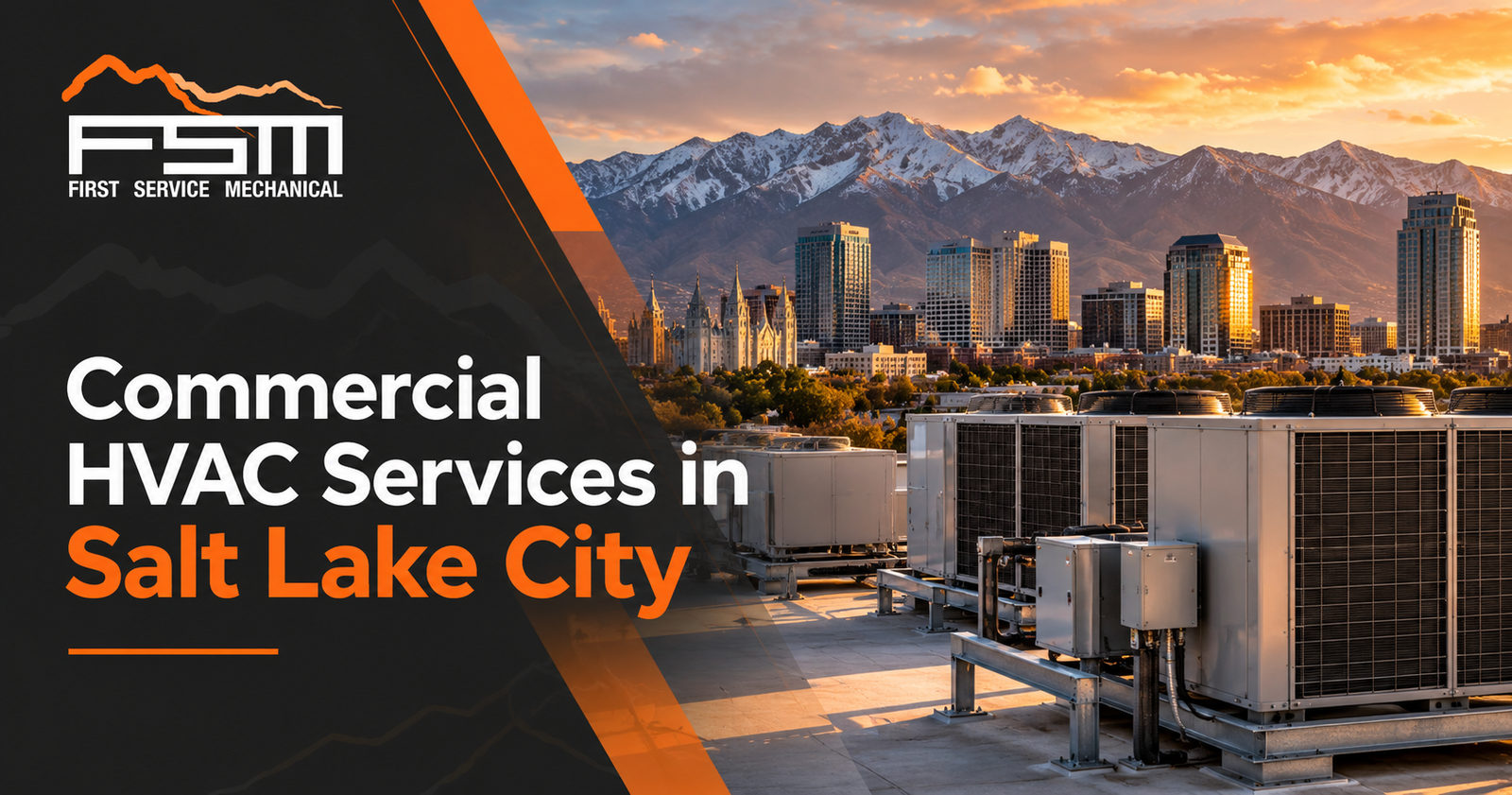
Commercial HVAC systems do much more than keep a building warm in the winter and cool in the summer. They affect employee and occupant comfort, energy consumption, equipment reliability, indoor conditions, and, for many facilities, the ability to maintain normal operations.
That makes choosing the right HVAC provider an important decision.
Businesses searching for commercial HVAC services in Salt Lake City should look beyond a company that can simply respond when an air conditioner or heater stops working. A full-service commercial HVAC partner should be able to maintain equipment, diagnose performance problems, support mechanical systems, improve controls, plan equipment upgrades, and help prevent unexpected failures.
First Service Mechanical provides comprehensive commercial HVAC services for commercial and industrial facilities throughout Utah’s Wasatch Front, including Salt Lake City. Understanding what those services should include can help facility managers determine what they need from an HVAC partner.
Commercial HVAC Equipment Service and Support
Every commercial facility has different heating and cooling requirements. An office building with several rooftop units has very different needs from an industrial property, healthcare facility, or building with specialized cooling equipment.
A commercial HVAC provider should understand how to service a wide range of equipment and, just as importantly, how that equipment interacts with the rest of the building.
FSM’s HVAC systems and equipment services cover rooftop units, HVAC retrofits, make-up air systems, swamp coolers, chiller and boiler start-ups, MRI cooling systems, telecommunications cooling, and other specialized applications.
When equipment begins causing problems, the answer isn’t necessarily replacement. Repairs, control improvements, airflow corrections, or targeted upgrades may be able to restore performance. Facility managers dealing with aging RTUs can learn more about the factors involved in FSM’s guide on when to repair or replace a commercial rooftop HVAC unit.
Preventive HVAC and Refrigeration Maintenance
Waiting for commercial HVAC equipment to fail can be expensive.
An unexpected breakdown can result in emergency repairs, uncomfortable building conditions, operational interruptions, and unplanned expenses. For facilities with mission-critical equipment or temperature-sensitive operations, the consequences can be even greater.
A strong commercial HVAC partnership should therefore include a proactive maintenance strategy.
HVAC and refrigeration maintenance allows technicians to regularly evaluate equipment condition, identify developing issues, and address maintenance needs before they become larger problems.
The appropriate maintenance schedule depends on factors such as equipment type, age, operating hours, environmental conditions, and facility requirements. Rather than relying on the same maintenance plan for every building, the program should reflect the actual systems being maintained.
Facility teams can also use a commercial HVAC and refrigeration maintenance checklist to understand some of the equipment and performance areas that should receive attention throughout the year.
HVAC Controls and System Optimization
Sometimes a commercial HVAC problem isn’t caused by the mechanical equipment itself.
Controls determine when equipment operates, how systems respond to building conditions, and how different components work together. Incorrect schedules, aging controls, inaccurate sensors, or poorly optimized sequences can cause equipment to operate unnecessarily or make it difficult to maintain consistent temperatures.
Professional HVAC controls and system optimization can help identify these issues and improve how the system operates as a whole.
This becomes especially important as buildings change.
Occupancy levels fluctuate. Spaces are renovated. Operating hours change. New equipment is installed. A control strategy that worked well several years ago may no longer match the facility’s current needs.
Optimizing controls can help improve comfort, system performance, reliability, and energy efficiency without automatically requiring major equipment replacement. FSM’s guide to commercial HVAC controls explains how these systems can influence efficiency, comfort, and equipment life.
Commercial HVAC Retrofits and Equipment Upgrades
Commercial HVAC equipment represents a major capital investment, which is why replacement should not automatically be the first recommendation when an older system begins losing performance.
In some cases, targeted upgrades can provide another option.
A commercial HVAC retrofit may involve upgrading specific components, improving controls, modifying airflow, or making other changes designed to improve an existing system.
FSM provides HVAC retrofit services as part of its commercial equipment capabilities, helping facilities evaluate ways to improve aging systems while considering reliability, performance, and long-term requirements.
Facility managers considering upgrades can learn more about when an HVAC retrofit may make more sense than complete replacement.
The right decision depends on the condition of the equipment, repair history, energy performance, facility requirements, budget, and expected remaining service life. A knowledgeable HVAC partner should help evaluate those factors rather than approaching every aging system with the same solution.
Commercial Refrigeration Services
For businesses that depend on refrigeration, HVAC expertise may need to extend beyond conventional heating and cooling.
Restaurants, commercial kitchens, industrial facilities, and other operations can rely on refrigeration equipment every day. Temperature inconsistencies or equipment failures can quickly become operational problems.
FSM’s commercial refrigeration services include support for low-temperature refrigeration systems, walk-in coolers and freezers, and commercial ice machines.
Including refrigeration and HVAC service under the same mechanical partner can also give facility teams a more complete view of the systems supporting their operations.
Piping and Mechanical Services
Commercial buildings contain interconnected mechanical systems, which means HVAC problems don’t always exist in isolation.
Gas piping, pumps, ductwork, sheet metal, equipment connections, and other mechanical components may all affect system performance.
Working with a provider that offers piping and mechanical services can simplify projects that extend beyond a single HVAC unit. FSM’s capabilities include gas piping, pump repair and replacement, and custom sheet metal work for commercial and industrial applications.
This broader expertise can be particularly useful during equipment upgrades, facility modifications, and projects involving multiple mechanical systems.
Start-Up and Commissioning Matter Too
Installing or replacing HVAC equipment is only part of the process. The equipment also needs to operate correctly once it is put into service.
Start-up and commissioning help verify system operation and identify performance issues that could otherwise remain unnoticed.
This process can include checking equipment operation, controls, airflow, sensors, and other system components. Existing facilities may also benefit from evaluating systems that have changed over time.
FSM explains the difference between these approaches in its guide to HVAC commissioning and retro-commissioning.
For facility managers, these services provide another layer of assurance that HVAC investments are delivering the performance they were intended to provide.
What Should You Look for in a Commercial HVAC Company in Salt Lake City?
Choosing a commercial HVAC contractor shouldn’t be based solely on who can respond to the next repair.
Consider whether the company can support your facility over the entire lifecycle of its mechanical systems.
That means looking for capabilities that include preventive maintenance, repairs, equipment upgrades, controls, system optimization, refrigeration, mechanical work, assessments, and long-term equipment planning.
Local experience matters as well. Salt Lake City commercial facilities must operate through hot summers, cold winters, and significant seasonal temperature changes. HVAC systems need to remain reliable across those changing conditions.
A provider that understands commercial equipment and local operating conditions can help facility teams take a more proactive approach instead of moving from one emergency repair to the next.
Get Commercial HVAC Services in Salt Lake City From First Service Mechanical
Your HVAC provider should do more than fix equipment when something breaks.
A full-service mechanical partner can help your organization maintain equipment, improve performance, identify problems earlier, plan upgrades, optimize controls, and make informed decisions about the future of your HVAC systems.
First Service Mechanical provides commercial HVAC services in Salt Lake City and throughout Utah’s Wasatch Front for commercial and industrial facilities. From HVAC equipment and refrigeration to controls, maintenance, retrofits, piping, mechanical work, and specialized cooling applications, FSM provides comprehensive support designed around the needs of each facility.
If you’re looking for a commercial HVAC partner that can support both your immediate equipment needs and your long-term facility goals, contact First Service Mechanical to discuss your building, equipment, and HVAC requirements.

Leave a Reply