

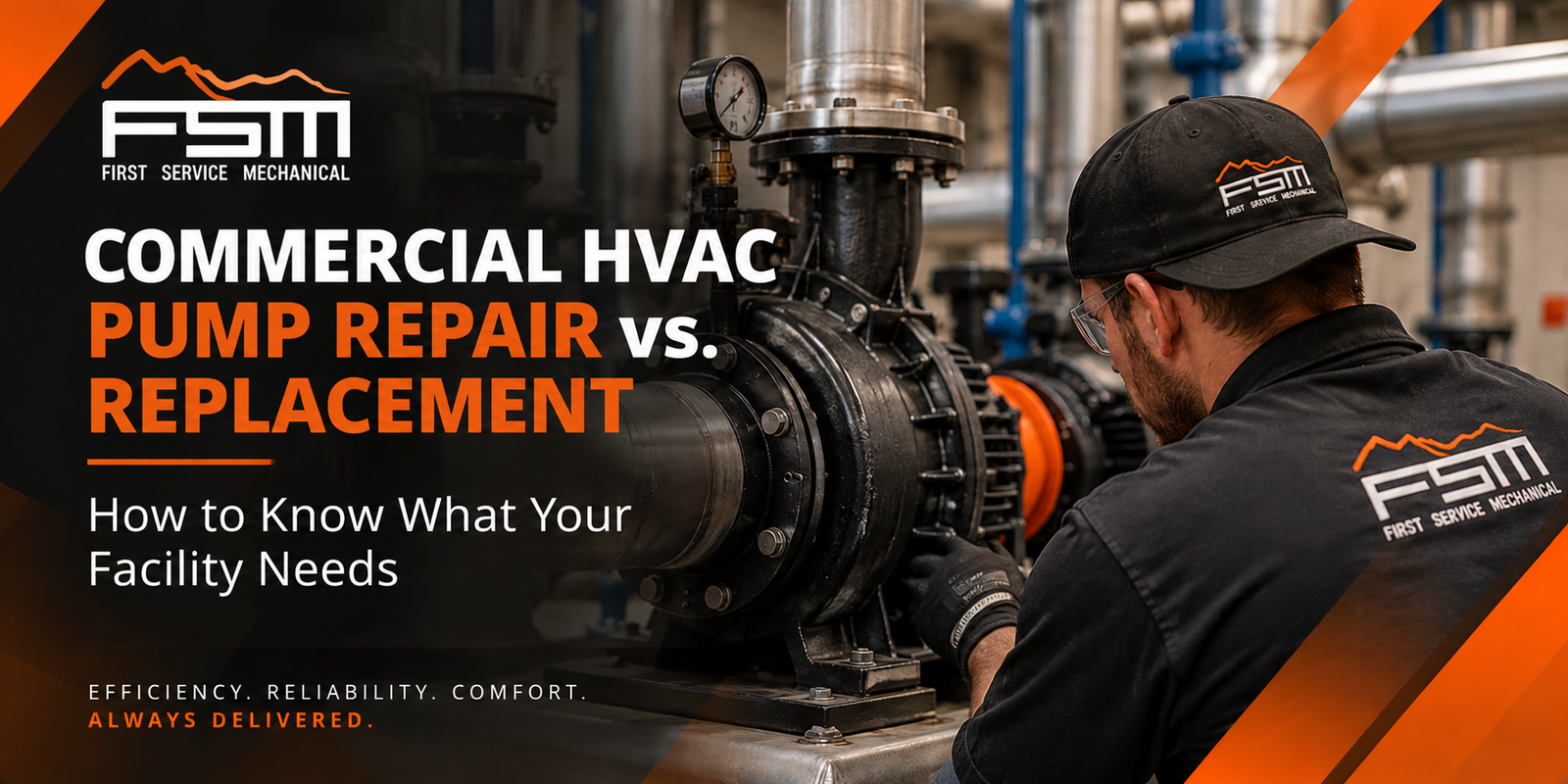
Pumps play a critical role in many commercial and industrial HVAC systems. They move water and other fluids through heating and cooling equipment, helping chillers, boilers, hydronic systems, and other mechanical equipment operate effectively.
Because pumps often operate behind the scenes, problems may go unnoticed until they begin affecting HVAC performance, energy use, or facility operations. A failing pump can contribute to inconsistent heating or cooling, unusual system noise, leaks, increased energy consumption, and eventually an unexpected shutdown.
When problems develop, facility managers face an important question: Should the commercial HVAC pump be repaired, or is it time to replace it?
The right answer depends on the condition of the pump, the cause of the problem, its age, repair history, and how the equipment fits into the facility’s overall mechanical system. Understanding these factors can help facility teams make a more informed decision and avoid repeatedly investing in equipment that is nearing the end of its useful life.
What Does a Pump Do in a Commercial HVAC System?
Many commercial HVAC systems depend on pumps to circulate water through the building’s mechanical equipment. Depending on the facility, pumps may support chilled water systems, hot water systems, boilers, cooling equipment, and other mechanical applications.
When a pump is operating correctly, it maintains the flow necessary for the system to transfer heating or cooling where it is needed.
A problem with the pump can therefore affect much more than the pump itself. Reduced flow can interfere with HVAC performance, make equipment work harder, and prevent parts of the building from receiving adequate heating or cooling.
That’s why pump service should be viewed as part of the facility’s larger mechanical system rather than as an isolated repair.
First Service Mechanical provides piping & mechanical services for commercial and industrial facilities, including professional pump troubleshooting, repair, and replacement.
Common Signs a Commercial HVAC Pump Needs Attention
Pump problems do not always result in an immediate system failure. In many cases, facilities experience smaller warning signs before a pump stops operating altogether.
Facility managers and maintenance teams should pay attention to issues such as:
- Unusual vibration or noise around the pump
- Water or fluid leaks
- Reduced heating or cooling performance
- Inconsistent system pressure or flow
- Frequent cycling or operational problems
- Rising energy consumption
- Repeated pump repairs
- Excessive heat around the equipment
- HVAC equipment struggling to maintain desired conditions
Some symptoms may originate with the pump itself, while others can be caused by problems elsewhere in the mechanical system. Proper troubleshooting is important before deciding whether a repair or replacement is necessary.
An HVAC operational assessment can also help facility teams evaluate equipment performance and identify vulnerabilities within the larger system, particularly when recurring mechanical problems are affecting reliability.
When Does Commercial HVAC Pump Repair Make Sense?
Not every pump problem requires new equipment. If the pump is otherwise in good condition and the problem involves a repairable component, commercial HVAC pump repair may restore reliable operation without the expense of a complete replacement.
Repair may make sense when the equipment is relatively early in its expected service life, the underlying problem is clearly identifiable, replacement parts are readily available, and the pump has not experienced repeated failures.
For example, certain leaks, worn components, alignment issues, or other mechanical problems may be correctable depending on the pump and system.
The key is determining whether the repair addresses the actual cause of the problem.
Repeatedly replacing individual components without investigating why they are failing can lead to additional service calls and downtime. A qualified commercial mechanical contractor should evaluate both the pump and the conditions under which it operates before recommending a repair.
When Should You Consider Commercial HVAC Pump Replacement?
Eventually, continuing to repair aging equipment can become less practical than replacement.
A pump may still be repairable from a technical standpoint, but that doesn’t necessarily mean another repair is the best long-term investment.
Commercial HVAC pump replacement may deserve consideration when:
Repairs are becoming more frequent. If the same pump repeatedly requires service, ongoing repair costs and disruptions can begin to outweigh the value of keeping it in operation.
The pump is aging. Equipment condition matters just as much as the immediate failure. Major repairs may provide limited value when other components are also approaching the end of their useful lives.
Parts are becoming difficult to obtain. Older equipment can become more challenging to maintain when replacement components are obsolete, expensive, or have long lead times.
The pump no longer meets the system’s needs. Building usage and mechanical systems can change over time. A pump selected for the facility years ago may no longer be appropriate after renovations, equipment changes, or operational growth.
Reliability is critical. In facilities where HVAC downtime can interrupt operations, repeatedly repairing unreliable equipment may create unnecessary operational risk.
For facilities managing multiple pieces of aging HVAC equipment, FSM’s HVAC systems & equipment services can help address equipment needs while considering long-term performance, reliability, and facility requirements.
Don’t Look at the Pump in Isolation
One of the most important parts of troubleshooting commercial pump problems is determining why the problem occurred.
Replacing a failed pump without addressing the underlying system condition can lead to the new equipment experiencing similar problems.
Flow conditions, system pressure, controls, equipment sizing, piping conditions, and other mechanical factors can all influence pump operation. Changes elsewhere in the facility can also affect equipment that previously operated without problems.
For example, a facility may have added equipment, changed its building layout, modified operating schedules, or completed renovations since the original mechanical system was installed.
Evaluating the complete system can help identify whether the pump itself is the problem or whether it is responding to another condition.
FSM’s HVAC controls & system optimization services focus on how HVAC equipment works together, helping facilities identify performance issues and make targeted adjustments that improve overall system operation.
The Hidden Cost of Waiting for a Pump to Fail
Waiting until equipment completely fails may seem easier than replacing a pump that is still operating, but an unexpected failure can create costs beyond the repair itself.
Depending on the pump’s function, failure can affect heating, cooling, process equipment, or other building operations. Emergency service, expedited parts, employee disruption, tenant complaints, and operational downtime can quickly increase the true cost of the failure.
This is especially important for commercial and industrial facilities with mission-critical systems or limited equipment redundancy.
A proactive approach gives facility managers more control. Instead of making a repair-or-replace decision during an emergency, they can evaluate equipment condition, compare options, schedule work around facility operations, and budget for future capital expenses.
How Preventive Maintenance Helps Protect Commercial Pumps
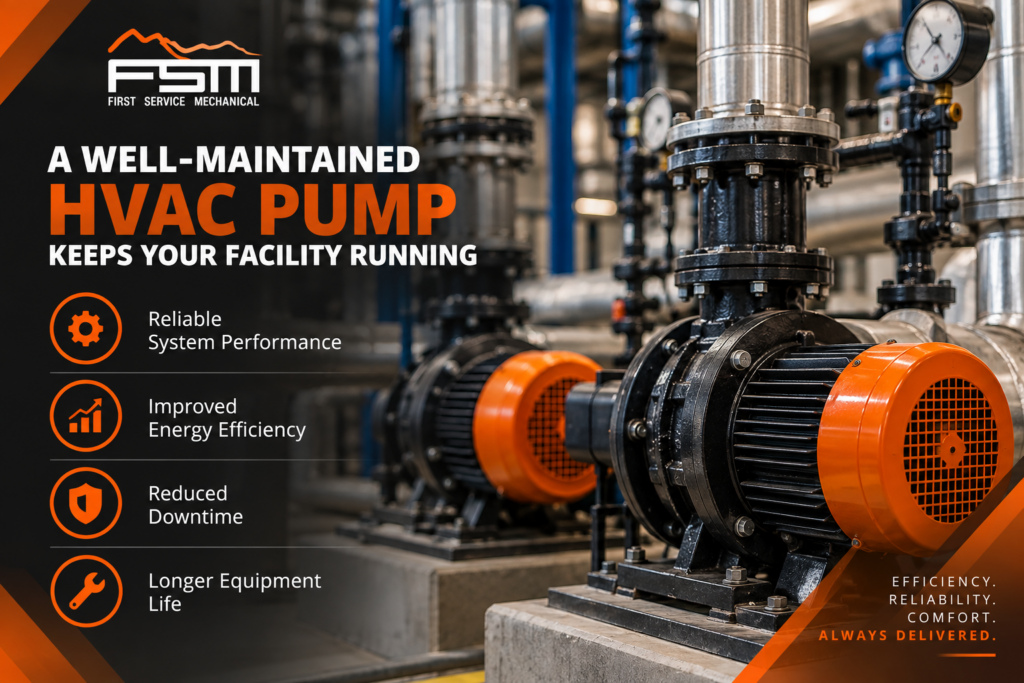
Routine maintenance is one of the best ways to identify developing mechanical issues before they result in an unexpected shutdown.
During scheduled maintenance, technicians can evaluate equipment condition, identify potential failure points, replace worn components, and look for performance issues that may require further attention.
FSM’s preventive maintenance programs are designed around the specific needs of a facility and its equipment, helping businesses extend equipment life, reduce unexpected downtime, and maintain system reliability.
Preventive maintenance also creates a history of equipment performance. If a pump begins requiring increasingly frequent attention, maintenance records can help facility managers recognize the trend and plan for replacement instead of waiting for a major failure.
Businesses looking for broader ongoing support can also explore FSM’s HVAC & refrigeration maintenance services, which include preventive maintenance agreements as well as system start-up and commissioning services.
Repair or Replace? Consider the Long-Term Cost
The lowest-cost option today isn’t always the lowest-cost option over the next several years.
When deciding between commercial HVAC pump repair and replacement, facility managers should consider more than the price of the immediate service call. Equipment age, reliability, repair frequency, operating performance, downtime risk, and future facility plans should all factor into the decision.
For a relatively new pump experiencing an isolated problem, repair may be the practical choice. For aging equipment with recurring issues, replacement may provide greater long-term reliability.
The goal isn’t simply to keep a pump running for as long as physically possible. It’s to keep the facility’s mechanical systems operating reliably while making smart use of maintenance and capital budgets.
Keep Your Facility’s Mechanical Systems Running Reliably
Pump problems can affect more than a single piece of equipment. They can reduce HVAC performance, create operational disruptions, and place additional stress on other parts of a commercial mechanical system.
First Service Mechanical provides commercial and industrial facilities with professional pump repair and replacement as part of our comprehensive piping & mechanical services. Our experienced technicians can troubleshoot equipment problems, evaluate system conditions, and help determine the appropriate solution based on your facility’s needs.
Whether you’re dealing with a developing pump issue, recurring equipment problems, or planning ahead for aging mechanical systems, contact First Service Mechanical to discuss your facility and keep your mechanical systems operating reliably.

Leave a Reply