

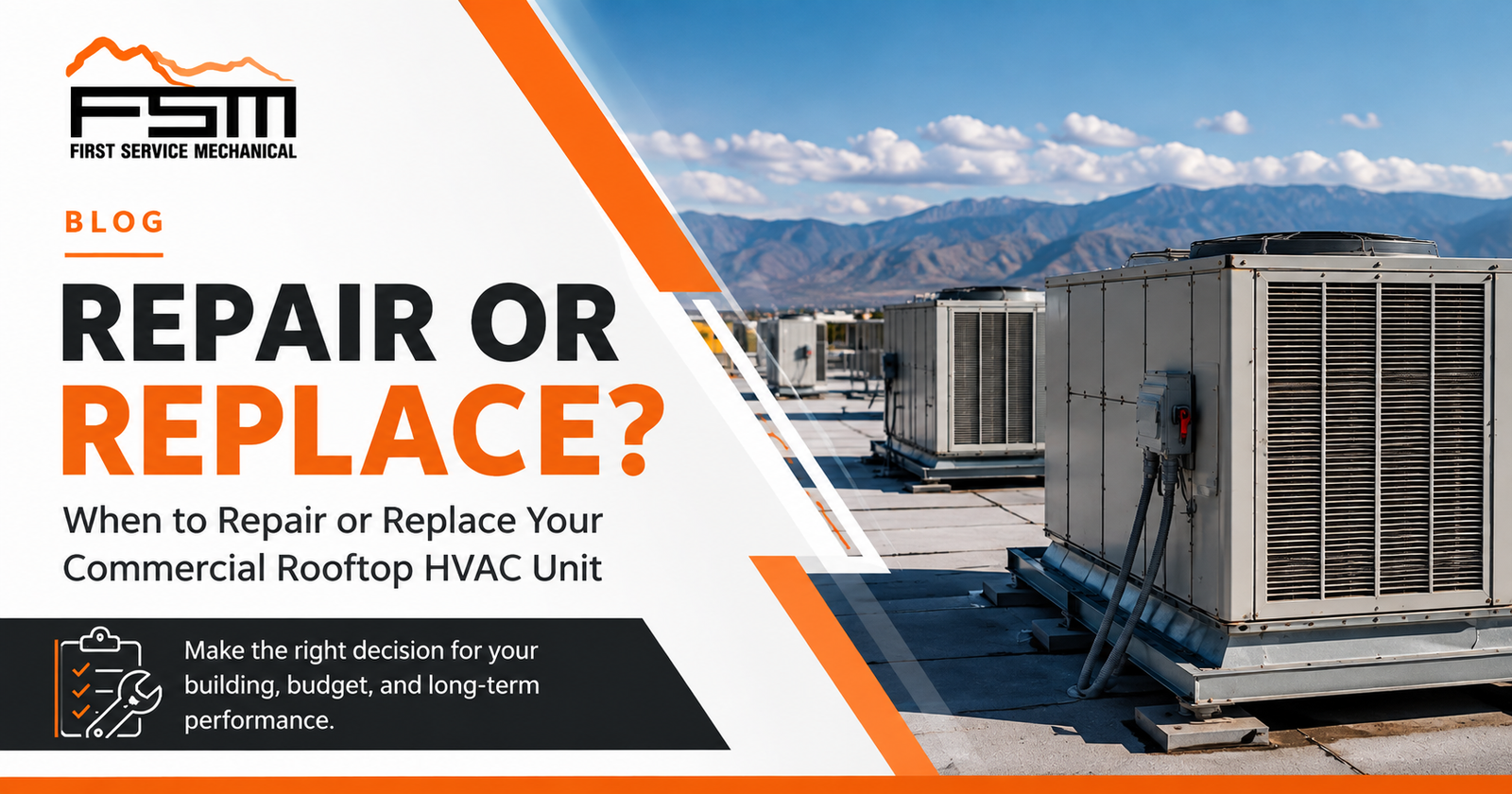
Commercial rooftop HVAC units work hard to keep buildings comfortable throughout the year. From offices and retail spaces to warehouses and other commercial facilities, rooftop units (RTUs) often handle a significant portion of a building’s heating, cooling, and ventilation needs.
Like any mechanical equipment, however, an RTU will eventually require more than routine maintenance. Components wear down, repairs become more frequent, efficiency can decline, and facility managers may find themselves facing an important question: Should we repair the rooftop HVAC unit again, or is it time to replace it?
There isn’t one answer that applies to every building. Equipment age matters, but so do maintenance history, operating conditions, repair costs, energy performance, comfort requirements, and the consequences of an unexpected failure.
Understanding these factors can help facility managers make a more informed decision and plan HVAC investments before an emergency forces their hand.
How Long Do Commercial Rooftop HVAC Units Last?
There is no universal expiration date for a commercial rooftop unit. Two identical systems installed at the same time can have very different service lives depending on how they are operated and maintained.
Several factors can influence an RTU’s useful life, including:
- Preventive maintenance history
- Daily operating hours
- Equipment sizing
- Local weather conditions
- Building occupancy and usage
- Airflow and ventilation requirements
- Frequency and severity of previous repairs
- Condition of electrical and mechanical components
- Changes made to the building over time
Utah’s climate can place additional demands on commercial HVAC equipment. Hot summer temperatures and cold winter conditions mean rooftop systems may experience substantial seasonal workloads.
That’s why age should be viewed as one part of the decision rather than the deciding factor. An older unit that has been consistently maintained may still have useful service life remaining, while a poorly maintained system can develop significant problems much sooner.
Signs Your Rooftop Unit May Be Approaching the End of Its Useful Life
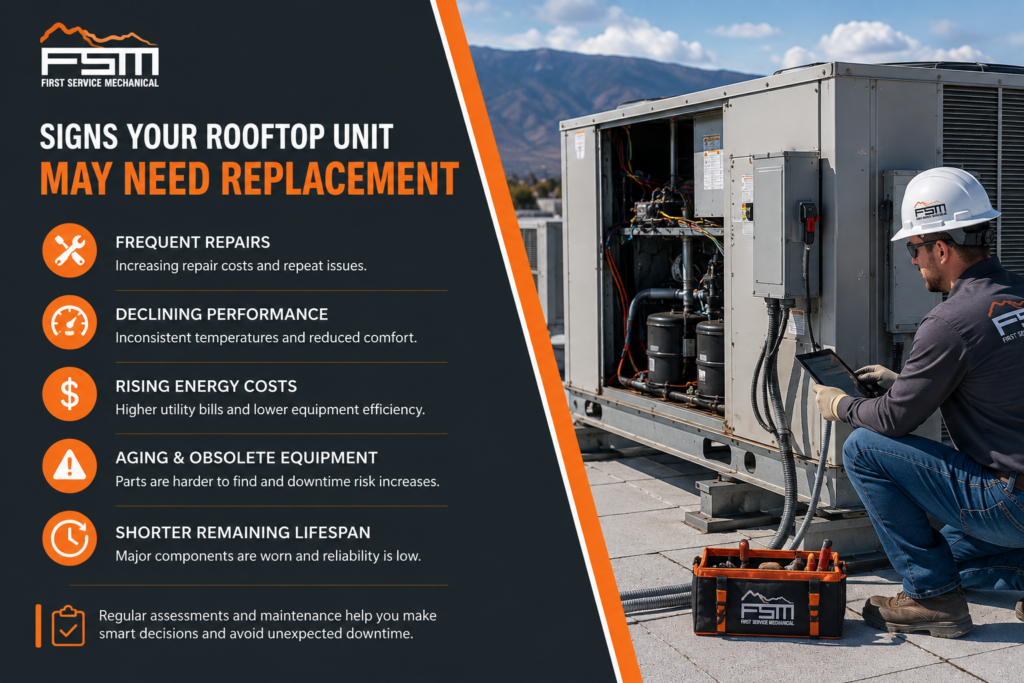
An occasional repair doesn’t necessarily mean an RTU needs to be replaced. When multiple performance issues begin appearing together, however, it may be time to evaluate the system more closely.
One warning sign is an increase in repair frequency. If technicians are repeatedly addressing different components or returning to the same unit for recurring problems, those repairs can begin adding up quickly.
Facility teams may also notice inconsistent temperatures throughout the building. Certain areas might become difficult to cool during the summer or heat during the winter. Employees or occupants may begin submitting more comfort complaints even though thermostat settings haven’t changed.
Other signs can include declining energy performance, unusual operating behavior, difficulty maintaining setpoints, excessive cycling, deteriorating components, or replacement parts becoming harder to obtain.
These symptoms don’t automatically mean replacement is necessary. They do indicate that a more comprehensive evaluation may be worthwhile.
When Repairing an RTU Still Makes Sense
Replacing commercial HVAC equipment is a significant investment, and there are plenty of situations where repairing the existing system remains the practical choice.
A repair may make sense when the unit is otherwise in good condition and the problem is isolated to a specific component. If the equipment has been well maintained, continues operating efficiently, and hasn’t experienced repeated failures, replacing a worn component could provide additional reliable service.
The type and cost of the repair should also be considered. A relatively straightforward repair on an otherwise dependable system is very different from investing heavily in equipment that has already experienced multiple major failures.
Maintenance records can be particularly helpful here. Reviewing several years of service history allows facility managers to see whether a recent issue is an isolated event or part of a larger pattern.
Rather than focusing only on today’s repair bill, consider what the equipment has cost to operate and maintain over time.
When Replacement Becomes the Better Investment
There comes a point when continuing to repair aging equipment may no longer make financial or operational sense.
Repeated repairs are one of the clearest indicators. A facility may approve one repair because it costs less than replacement, followed by another several months later and another after that. Individually, each decision can seem reasonable. Collectively, the facility may be putting significant money into equipment that is becoming increasingly unreliable.
Operational risk should also be considered.
For some commercial facilities, an HVAC failure is inconvenient. For others, it can disrupt operations, affect employees or customers, interfere with temperature-sensitive processes, or create conditions that require portions of the building to close.
The cost of failure can therefore extend well beyond the HVAC repair itself.
Older equipment may also lack the efficiency and control capabilities available with newer systems. Replacement can create an opportunity to evaluate whether the existing equipment still matches the building’s current requirements.
Don’t Evaluate the Rooftop Unit in Isolation
One of the biggest mistakes when diagnosing commercial HVAC problems is assuming the rooftop unit itself is always responsible.
Commercial buildings operate as interconnected systems. Airflow problems, control issues, ductwork deficiencies, building pressure, changing occupancy patterns, and other factors can all affect HVAC performance.
For example, replacing an RTU may not resolve comfort problems if inadequate airflow is the underlying issue. Likewise, equipment that appears inefficient may be responding to incorrect control sequences or operating schedules.
Buildings also change over time. Spaces are renovated, occupancy levels shift, layouts change, equipment is added, and operating hours expand. An HVAC system designed for the building years ago may no longer be optimized for how the facility operates today.
Before making a major capital investment, a comprehensive assessment can help identify what is actually causing the problem.
Look at Controls and Airflow Before Making the Decision
Controls deserve particular attention when evaluating rooftop equipment.
A mechanically sound RTU can still perform poorly when control strategies are outdated, sensors aren’t operating correctly, schedules don’t reflect occupancy, or equipment isn’t communicating properly with the rest of the building.
Airflow is another important piece of the puzzle. Restricted airflow, unbalanced distribution, dirty components, or ductwork problems can reduce comfort and place unnecessary stress on HVAC equipment.
Evaluating these systems together provides a more complete picture of equipment condition and building performance.
Sometimes the result may point toward replacement. In other situations, adjusting controls, correcting airflow, repairing components, or improving maintenance practices may help extend the equipment’s useful life.
Plan RTU Replacement Before It Becomes an Emergency
The worst time to decide whether to replace a rooftop HVAC unit is often immediately after it fails.
Emergency decisions limit options. Facility managers may have less time to evaluate equipment choices, coordinate budgets, consider efficiency improvements, or plan installation around business operations.
Preventive maintenance provides an opportunity to identify deteriorating equipment earlier.
Regular inspections can reveal worn components, declining performance, unusual operating conditions, and other warning signs before they become major failures. Maintenance records can also help organizations identify trends across multiple units.
For buildings with several RTUs, this information becomes especially valuable. Instead of replacing equipment reactively as it fails, facility managers can develop a phased replacement strategy based on condition, criticality, repair history, and available budget.
A planned approach can make capital expenditures more predictable while reducing the risk of unexpected downtime.
Think in Terms of Lifecycle Cost
The cheapest option today isn’t always the least expensive option over the next several years.
When comparing repair and replacement, facility managers should consider the complete lifecycle cost of the equipment. That can include repair expenses, preventive maintenance, energy consumption, downtime risk, replacement parts, and the remaining expected service life.
Suppose an aging unit requires a substantial repair. If the repair is likely to provide several more years of dependable operation, it may be a reasonable investment.
If that same unit has experienced repeated failures, consumes excessive energy, and has other major components nearing the end of their service life, replacement may provide better long-term value.
The goal isn’t to replace equipment simply because it is old. It’s to make informed decisions based on the actual condition and performance of the system.
Build a Better Plan for Your Commercial HVAC Equipment
Commercial rooftop HVAC equipment represents a significant investment, and deciding whether to repair or replace a unit shouldn’t come down to guesswork.
A combination of preventive maintenance, equipment assessments, service history, controls evaluation, airflow analysis, and lifecycle planning can provide a much clearer understanding of where each RTU stands.
First Service Mechanical helps commercial facilities throughout Utah maintain, repair, evaluate, and improve their mechanical systems. By looking beyond individual equipment problems and considering the building as a whole, our team can help identify practical solutions that support comfort, reliability, efficiency, and long-term planning.
If you’re dealing with an aging rooftop unit or want a better understanding of your facility’s HVAC equipment, contact First Service Mechanical to schedule an assessment and start planning your next steps.

Leave a Reply