

Commercial boilers play an essential role in keeping buildings comfortable, maintaining reliable heating, and supporting daily operations. From office buildings and healthcare facilities to warehouses and industrial properties, these systems must perform consistently throughout the colder months.
However, commercial boilers can develop performance issues long before a complete breakdown occurs. Changes in heating output, unusual operating noises, pressure fluctuations, and rising energy costs may indicate that equipment requires professional attention.
For facility managers, recognizing these warning signs early can help prevent unexpected downtime and expensive repairs. A proactive approach to commercial boiler maintenance supports equipment reliability, improves operating efficiency, and helps protect critical building systems.
Why Commercial Boiler Maintenance Matters
Commercial boilers operate under demanding conditions, particularly in facilities with extensive heating requirements or long operating hours. Over time, normal wear, sediment accumulation, control issues, and mechanical problems can affect their performance.
Without regular maintenance, these issues may increase energy consumption, reduce heating capacity, and place additional stress on system components.
Professional commercial boiler maintenance helps facility managers identify developing problems before they become major disruptions. Routine inspections also provide opportunities to evaluate system efficiency, verify proper operation, and plan necessary repairs.
As discussed in our article on why preventative HVAC maintenance saves commercial buildings thousands, addressing equipment concerns proactively can help businesses control long-term maintenance expenses.
6 Warning Signs Your Commercial Boiler Needs Professional Service
Boiler problems do not always result in immediate equipment failure. In many cases, changes in operation provide early indications that something is wrong.
Facility managers should pay attention to the following warning signs.
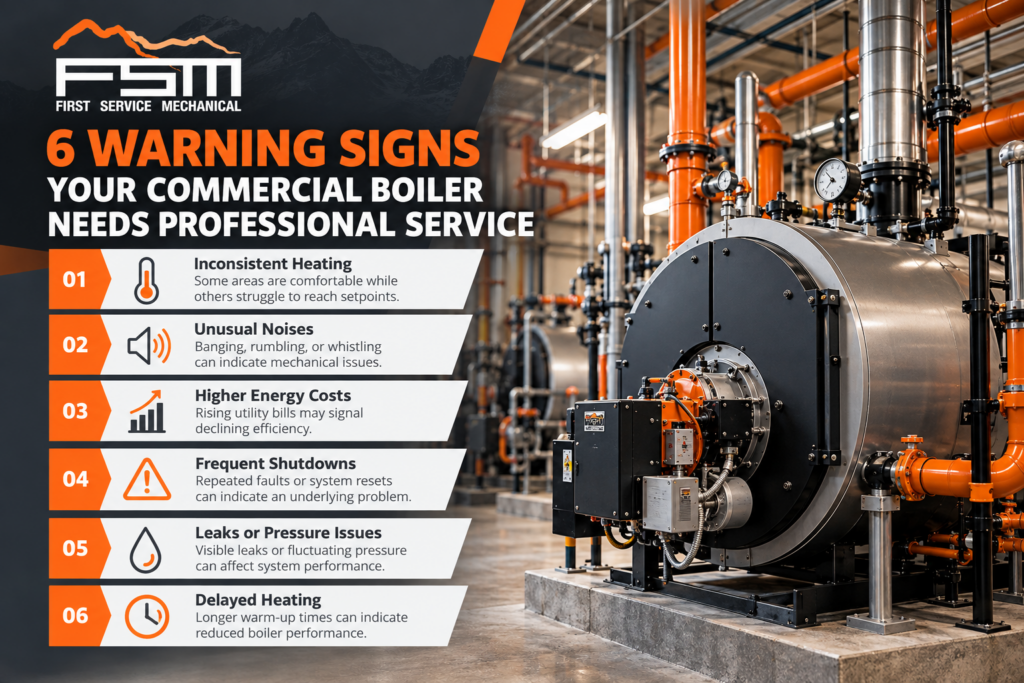
1. Inconsistent Heating Throughout the Building
One of the most noticeable signs of boiler performance problems is uneven heating.
Some areas of a building may maintain comfortable temperatures while others struggle to reach their setpoints. This can occur when the boiler cannot consistently meet heating demand or when distribution components are not operating correctly.
Potential contributing factors include:
- Circulation pump problems
- Improper water flow
- Control system malfunctions
- Air trapped in hydronic piping
- Reduced boiler heating capacity
Inconsistent temperatures may also indicate problems elsewhere in the building’s heating distribution system.
Professional evaluation can help determine whether the issue originates with the boiler, piping, pumps, or controls.
2. Unusual Noises During Operation
Commercial boilers typically produce some operational noise. However, new or increasingly noticeable sounds may indicate developing mechanical problems.
Banging, rumbling, whistling, or vibrating noises can be associated with several conditions, including restricted circulation, scale accumulation, or malfunctioning components.
These symptoms should not be ignored, particularly when accompanied by reduced heating performance or operational interruptions.
A qualified technician can evaluate the equipment, identify the source of unusual noises, and recommend appropriate corrective action.
3. Unexpected Increases in Energy Consumption
An unexplained increase in heating costs may indicate that a commercial boiler is operating less efficiently than expected.
Scale buildup, improper combustion, malfunctioning controls, and reduced heat transfer performance can cause boilers to consume more energy while delivering the same heating output.
Facility managers should compare current utility consumption with historical performance while accounting for outdoor temperatures, occupancy, and operating schedules.
If energy consumption increases without a corresponding change in heating demand, professional boiler inspection may be appropriate.
Businesses can also explore HVAC efficiency optimization services to identify opportunities for improving overall mechanical system performance.
4. Frequent Shutdowns or System Faults
Modern commercial boilers rely on safety devices, sensors, and control systems to maintain appropriate operating conditions.
When equipment repeatedly shuts down, generates fault codes, or requires frequent resets, an underlying problem may be affecting system operation.
Potential causes include faulty sensors, ignition problems, circulation issues, or other equipment malfunctions.
Repeated shutdowns can interrupt building heating and create additional stress on mechanical components.
Rather than repeatedly restarting equipment, facility managers should arrange professional troubleshooting to determine why the system is experiencing faults.
5. Water Leaks or Pressure Irregularities
For commercial hot-water boiler systems, maintaining appropriate operating pressure is essential for reliable heating performance.
Unexpected pressure changes, visible leaks, or frequent makeup-water requirements may indicate problems involving piping connections, expansion tanks, valves, or other system components.
Even relatively small leaks can affect system operation and contribute to equipment deterioration over time.
These concerns may require both boiler evaluation and professional piping and mechanical services to address problems throughout the heating system.
Because pressure-related problems can involve significant safety risks, inspection and corrective work should be handled by qualified professionals.
6. Delayed Heating or Reduced System Performance
A commercial boiler that takes longer than usual to satisfy heating demand may be experiencing declining performance.
Facility managers might notice longer operating cycles, slower building warm-up times, or difficulty maintaining temperatures during colder weather.
Possible causes include heat transfer restrictions, control problems, inadequate circulation, or deteriorating equipment components.
These symptoms can become particularly noticeable during periods of high heating demand.
Scheduling professional service before peak winter conditions can help identify performance limitations while allowing more time to plan necessary repairs.
What Does Professional Commercial Boiler Maintenance Include?
Commercial boiler maintenance requirements vary depending on equipment design, fuel type, manufacturer recommendations, and operating conditions.
A professional maintenance program may include:
- Inspecting boiler components for wear or deterioration
- Evaluating burners and combustion performance
- Checking operating temperatures and pressures
- Inspecting safety controls and protective devices
- Evaluating pumps and circulation performance
- Checking for leaks and corrosion
- Inspecting heat transfer surfaces
- Reviewing control settings and operating sequences
- Testing system performance under appropriate conditions
Some equipment may also require specialized water treatment evaluations, cleaning procedures, or additional inspections.
First Service Mechanical provides HVAC and refrigeration maintenance services designed to support reliable equipment operation through preventive maintenance, system start-up, and commissioning.
How Often Should Commercial Boilers Be Inspected?
Commercial boiler inspection frequency depends on several factors, including equipment type, operating hours, system age, manufacturer requirements, and applicable regulations.
Many facilities schedule comprehensive professional maintenance annually, often before the heating season begins. However, some boilers require more frequent inspections, operational checks, and specialized servicing.
Facilities with continuous heating demands or critical operations may benefit from additional monitoring throughout the year.
A structured maintenance program should account for equipment condition, operating history, and the consequences of an unexpected shutdown.
For broader facility planning, our commercial HVAC and refrigeration maintenance checklist explains important considerations for maintaining mechanical equipment throughout the year.
Preventive Maintenance vs. Emergency Boiler Repairs
Preventive maintenance allows facility managers to address developing equipment concerns before they interfere with building operations.
Scheduled inspections provide opportunities to identify worn components, evaluate performance trends, and plan repairs around operational requirements.
Emergency boiler repairs, however, often occur when heating equipment has already experienced a significant malfunction.
Unexpected failures can create uncomfortable indoor conditions, interrupt business activities, and require urgent service during periods of high heating demand.
Although not every breakdown is preventable, consistent maintenance can reduce certain equipment risks and help facilities prepare for future repairs or replacements.
Facility managers should also consider how maintenance decisions affect long-term operating budgets. Our article on how deferred HVAC maintenance impacts commercial facility budgets explores the financial consequences of postponing necessary service.
Keep Your Commercial Heating Systems Reliable With First Service Mechanical
Commercial boilers are critical investments that require professional attention to maintain dependable performance.
Recognizing warning signs, scheduling appropriate inspections, and addressing developing problems can help facility managers reduce unexpected downtime and maintain reliable heating throughout the colder months.
First Service Mechanical supports commercial and industrial facilities throughout Utah with experienced HVAC maintenance, boiler start-up capabilities, mechanical services, and equipment support.
Whether your facility is experiencing heating inconsistencies, unusual equipment behavior, or declining system performance, our team can help evaluate your mechanical systems and identify appropriate service solutions.
Keep your commercial heating systems operating reliably. Contact First Service Mechanical to discuss your facility’s boiler maintenance and mechanical service needs.

Leave a Reply