

When temperatures climb during Utah’s dry summers, keeping a commercial or industrial facility comfortable can require a significant amount of energy. While traditional air conditioning is common, it is not the only option available. In the right environment, a swamp cooler can provide an efficient way to cool large spaces while introducing fresh outdoor air.
But how does a swamp cooler work, and when does it make sense for a commercial building?
Also known as an evaporative cooler, a swamp cooler uses the natural process of evaporation to lower the temperature of outdoor air before circulating it through a building. The concept is relatively simple, but proper sizing, airflow, maintenance, and facility conditions all play important roles in determining how effectively the system performs.
What Is a Swamp Cooler?
A swamp cooler is a cooling system that uses water evaporation rather than a traditional refrigeration cycle.
Conventional air conditioning systems typically use refrigerant, compressors, condensers, and evaporator coils to remove heat from indoor air. A swamp cooler takes a different approach. It draws warm, dry outdoor air through water-saturated cooling media. As the water evaporates, it absorbs heat from the incoming air and reduces its temperature.
A fan or blower then distributes the cooled air throughout the building.
Because the process continuously introduces outdoor air, swamp coolers are particularly useful in certain commercial and industrial environments where ventilation and air movement are important.
How Does a Swamp Cooler Work?
The basic operation of a swamp cooler can be broken down into a few steps.
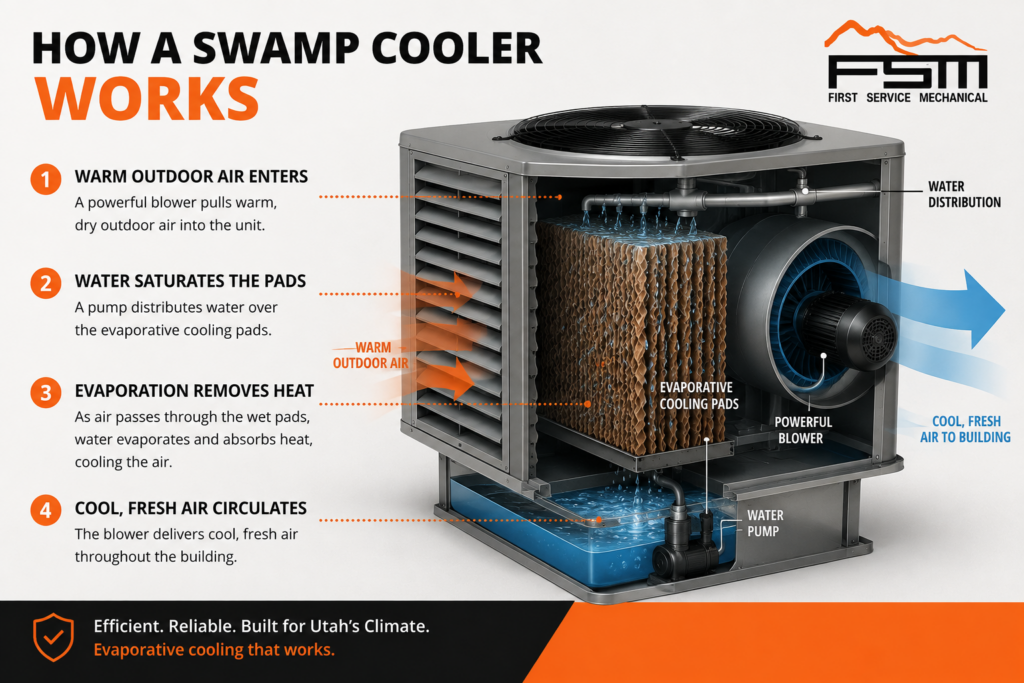
1. Outdoor Air Enters the Unit
The system begins by pulling warm outdoor air into the cooler. This is one reason climate matters so much. Evaporative cooling performs best when the outdoor air is relatively dry.
2. Water Saturates the Cooling Media
A pump circulates water from the cooler’s reservoir to pads or other evaporative media inside the unit. The media is designed to provide a large wet surface area while allowing air to pass through it.
3. Evaporation Removes Heat
As hot, dry air passes through the wet media, some of the water evaporates. Evaporation requires heat, which is pulled from the incoming air. As a result, the air leaving the cooling media is cooler than the air that entered the system.
4. Cooled Air Moves Through the Facility
A blower pushes the cooled air into the building. Depending on the system and facility design, that air may be distributed through ductwork or directly into a particular area. Unlike traditional air conditioning, an evaporative cooler generally relies on continuous air exchange. Warm indoor air needs a path to leave the building as fresh, cooled air enters.
Why Swamp Coolers Work Well in Dry Climates
Humidity has a major effect on evaporative cooling.
When outdoor air is dry, it can absorb more moisture. That allows water inside the cooler to evaporate more effectively and remove more heat from the incoming air. When humidity is already high, the air cannot absorb as much additional moisture. The cooling effect is therefore reduced.
This is why evaporative cooling is commonly associated with dry western climates. For some commercial and industrial facilities in Utah, these conditions can make swamp coolers a practical part of a building’s cooling strategy.
However, climate alone does not determine whether a swamp cooler is appropriate. Facility layout, heat loads, ventilation requirements, operating schedules, equipment, occupancy, and desired indoor conditions should all be considered.
Swamp Coolers vs. Traditional Air Conditioning
Although both systems cool buildings, they operate very differently.
Traditional air conditioning recirculates and conditions indoor air using a refrigeration cycle. It can provide precise temperature and humidity control across a wide range of outdoor conditions.
Swamp coolers continuously introduce outdoor air and rely on evaporation. They also add moisture to the air as part of the cooling process.
Some potential advantages of evaporative cooling include:
- Lower energy consumption in appropriate applications
- Continuous introduction of fresh outdoor air
- Relatively straightforward mechanical operation
- Effective cooling in dry environments
- Strong airflow for large or open spaces
However, evaporative cooling is not appropriate for every building. Facilities that require tight temperature or humidity control may need other HVAC solutions.
The decision should be based on how the building operates rather than simply choosing whichever system appears less expensive to run.
Where Are Commercial Swamp Coolers Used?
Swamp coolers can be particularly useful in large, open facilities where substantial airflow is needed.
Potential applications include:
- Warehouses
- Manufacturing facilities
- Workshops
- Maintenance facilities
- Distribution areas
- Commercial garages
- Large open production spaces
- Certain mixed-use facilities
The suitability of evaporative cooling depends heavily on the specific environment.
For example, a manufacturing facility with significant internal heat loads may have very different cooling requirements from an office building. A facility containing sensitive equipment or processes may also have strict humidity requirements that affect whether evaporative cooling is appropriate.
A professional HVAC assessment can help determine whether an existing swamp cooler is meeting the building’s needs or whether another solution would provide better long-term performance.
Why Airflow Is Critical
One of the most important parts of evaporative cooling is often overlooked: air needs somewhere to go.
A swamp cooler continuously pushes fresh air into a building. Without adequate exhaust or relief pathways, pressure can build and airflow can become ineffective.
Doors, windows, exhaust systems, louvers, or other ventilation components may be incorporated into the building’s overall airflow strategy.
Proper air distribution matters as well. Even if the cooler itself is operating correctly, poor duct design, blocked airflow, improperly positioned diffusers, or changes to the facility layout can create hot spots and inconsistent temperatures.
That makes the swamp cooler only one component of a larger ventilation and cooling system.
Swamp Cooler Maintenance Matters
The simplicity of evaporative cooling does not eliminate the need for maintenance.
Swamp coolers rely on water, moving air, pumps, motors, belts, controls, and evaporative media. Problems with any of these components can reduce cooling capacity or lead to equipment failure.
Commercial swamp cooler maintenance may include checking:
- Cooling media condition
- Water distribution
- Pumps and water lines
- Reservoirs and drains
- Fan and blower assemblies
- Motors and belts
- Electrical components
- Controls
- Airflow
- Scale and mineral buildup
Mineral buildup can be a particular concern because evaporative cooling continuously uses water. Over time, deposits can interfere with water distribution and reduce system performance.
Routine inspection gives facility managers an opportunity to address smaller issues before they cause a loss of cooling during hot weather.
Signs a Commercial Swamp Cooler May Need Service
A change in cooling performance does not necessarily mean the entire system needs to be replaced.
Common warning signs can include reduced airflow, inconsistent cooling, unusual noises, water leaks, excessive mineral buildup, or a system that runs without delivering the expected temperature reduction.
Facility managers may also notice that certain areas have become warmer even though the equipment appears to be operating normally.
These symptoms can result from equipment problems, but they may also indicate airflow or building-related changes. Renovations, new walls, additional machinery, increased occupancy, or changes to ventilation can alter cooling requirements.
An HVAC assessment can help identify the actual cause before major equipment decisions are made.
Improving Long-Term Swamp Cooler Performance
Commercial HVAC equipment should be evaluated as part of the facility’s overall mechanical system.
Instead of waiting for a swamp cooler to stop working, facility managers can use preventive maintenance to identify worn components, airflow issues, water distribution problems, and opportunities to improve efficiency.
This is especially important for businesses that depend on reliable cooling to maintain employee comfort, support production, or protect equipment.
A proactive approach can also help facility managers understand when repairs remain cost-effective and when upgrading or replacing equipment makes more financial sense.
Commercial Swamp Cooler Service from First Service Mechanical
Understanding how a swamp cooler works is useful, but getting the best performance from one requires more than keeping water in the reservoir and turning on the fan. Airflow, equipment condition, facility requirements, ventilation, controls, and ongoing maintenance all influence performance.
First Service Mechanical provides commercial and industrial HVAC services throughout Utah, including swamp cooler service as part of its broader mechanical capabilities. FSM also supports facilities with HVAC assessments, preventive maintenance, emergency services, repairs, system upgrades, and efficiency improvements.
Whether your facility currently relies on evaporative cooling or you are evaluating ways to improve an existing HVAC system, a professional assessment can help identify the best approach for your building.
Contact First Service Mechanical to discuss your commercial HVAC needs and keep your facility operating efficiently throughout Utah’s cooling season.

Leave a Reply