

Commercial HVAC systems depend on efficient heat transfer to maintain reliable heating, cooling, and temperature control. Whether a facility operates boilers, chillers, or hydronic heating and cooling systems, heat exchangers play an important role in overall equipment performance.
When heat exchangers develop problems, facilities may experience declining efficiency, inconsistent temperatures, increased energy consumption, and unexpected equipment downtime. Unfortunately, these issues often develop gradually, making them difficult to recognize until system performance noticeably deteriorates.
Understanding common commercial HVAC heat exchanger problems can help facility managers identify warning signs, address developing issues, and protect critical mechanical equipment.
What Does a Heat Exchanger Do in a Commercial HVAC System?
A heat exchanger transfers thermal energy between two fluids, or between a fluid and air, without necessarily allowing them to mix.
In commercial HVAC applications, heat exchangers support several important functions:
- Boiler systems: Transfer heat to water or other heating media used throughout a facility.
- Chilled water systems: Transfer heat between water circuits or other cooling media.
- Hydronic heating systems: Support efficient heating distribution throughout commercial buildings.
- Industrial cooling applications: Remove excess heat from equipment and temperature-sensitive processes.
- Heat recovery systems: Capture and reuse thermal energy that would otherwise be wasted.
When these components operate correctly, they help mechanical systems maintain intended temperatures and operating conditions.
However, contamination, corrosion, restricted flow, and mechanical deterioration can interfere with heat transfer and reduce overall system efficiency.
Common Warning Signs of Commercial HVAC Heat Exchanger Problems
Heat exchanger problems do not always cause immediate equipment failure. Many begin with subtle performance changes that become more noticeable over time.
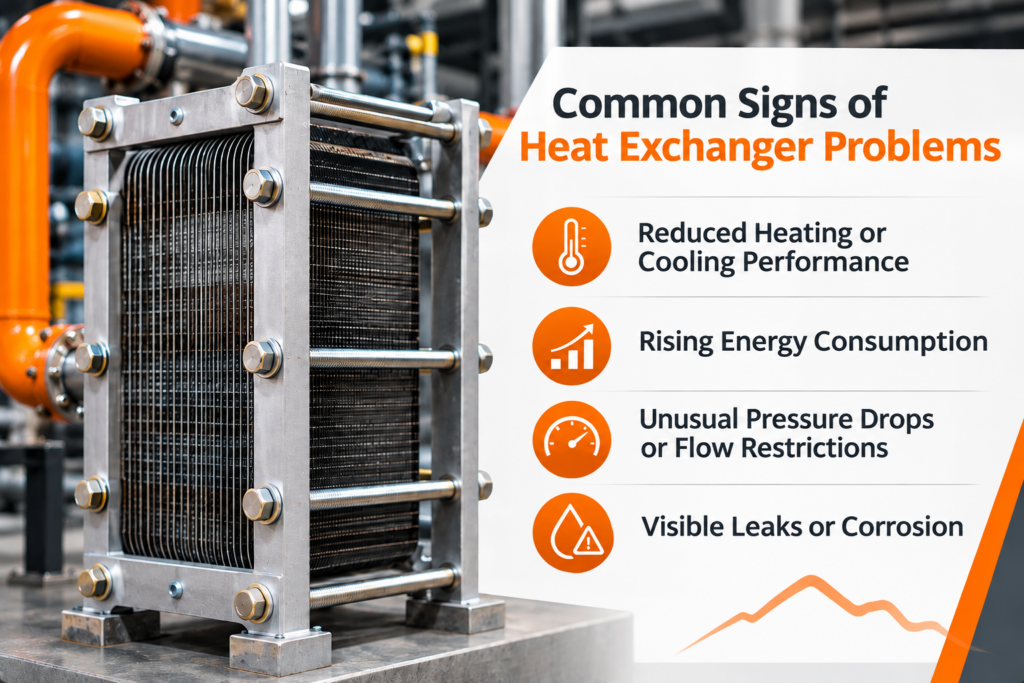
1. Reduced Heating or Cooling Performance
One of the most common warning signs is difficulty maintaining required temperatures.
A facility may notice that its heating system takes longer to reach setpoints or that chilled water temperatures remain higher than expected.
These symptoms can indicate reduced heat transfer caused by fouling, scaling, restricted flow, or other mechanical problems.
However, similar symptoms can originate elsewhere in the HVAC system. Professional evaluation is necessary to determine whether the heat exchanger is responsible.
2. Rising Energy Consumption
When heat transfer becomes less efficient, connected equipment may need to operate longer or under greater load to meet building demands.
For example, a fouled heat exchanger can reduce the effectiveness of a chilled water system, potentially increasing the energy required to maintain cooling performance.
Facility managers experiencing unexplained utility increases should consider heat exchanger performance as part of a broader mechanical system assessment.
For additional information, read our article on signs your commercial HVAC system is wasting energy.
3. Unusual Pressure Drops or Flow Restrictions
Changes in pressure differential across a heat exchanger can indicate developing restrictions.
Mineral deposits, sediment, and other contaminants may accumulate within passages, reducing the available area for fluid circulation.
Restricted flow can affect heat transfer performance and place additional demands on associated pumps and mechanical equipment.
Monitoring pressure and flow trends helps technicians identify potential problems before they significantly affect operations.
4. Visible Leaks or Corrosion
Heat exchangers operate under varying temperatures and pressures, making component integrity essential.
Visible leakage, corrosion, or unexplained fluid loss may indicate deterioration of tubes, plates, seals, or connections.
These conditions require professional attention because continued operation can lead to equipment damage, contamination between fluid circuits, or unplanned shutdowns.
What Causes Commercial Heat Exchanger Failure?
Several mechanical and operational conditions can contribute to declining heat exchanger performance.
Fouling and Mineral Scale
Fouling occurs when contaminants accumulate on heat transfer surfaces. These deposits create resistance to thermal energy transfer, reducing efficiency.
Mineral scaling is particularly relevant in water-based systems, where dissolved minerals can accumulate on internal surfaces.
According to the U.S. Department of Energy’s guidance on cooling tower filtration, fouling and scaling can reduce heat transfer efficiency and increase the energy required by cooling equipment.
Maintaining appropriate water quality and inspecting heat transfer surfaces can help limit these problems.
Corrosion and Material Deterioration
Corrosion can develop when heat exchanger materials are exposed to unfavorable water chemistry, oxygen, or other corrosive conditions.
Over time, corrosion may weaken components, contribute to leaks, or create deposits that interfere with performance.
Proper water treatment, material compatibility, and routine inspections help reduce corrosion-related risks.
Thermal Stress and Repeated Temperature Changes
Commercial mechanical systems frequently experience temperature fluctuations as equipment starts, stops, and responds to changing building demands.
Repeated expansion and contraction can place stress on heat exchanger components.
Over time, excessive thermal cycling may contribute to fatigue, seal deterioration, or other mechanical problems.
Improper Flow Conditions
Heat exchangers are designed to operate within specific flow and temperature ranges.
Insufficient flow, excessive velocity, or improperly balanced systems can reduce performance and contribute to premature deterioration.
Because these problems may involve associated pumps, valves, and piping, technicians must evaluate the surrounding mechanical system rather than focusing exclusively on the heat exchanger.
How Heat Exchanger Problems Affect Commercial Facilities
The consequences of heat exchanger problems extend beyond reduced equipment efficiency.
In healthcare environments, dependable temperature control may be necessary to support sensitive equipment and critical building operations.
Manufacturing facilities may depend on consistent heating or cooling to maintain production conditions.
Office buildings, educational facilities, and commercial properties rely on mechanical systems to provide dependable occupant comfort.
When heat transfer performance declines, these facilities may face higher operating costs, increased equipment wear, inconsistent temperatures, and unexpected service interruptions.
For buildings with central cooling systems, heat exchanger issues may also affect chiller performance. Our guide to commercial chiller maintenance explains additional warning signs facility managers should monitor.
Heat Exchanger Repair vs. Replacement: What Should Facility Managers Consider?
Not every heat exchanger problem requires complete equipment replacement.
Some performance issues can be corrected through professional cleaning, component repairs, flow adjustments, or improvements to water treatment practices.
However, replacement may become necessary when equipment experiences significant corrosion, repeated leakage, structural deterioration, or damage that cannot be reliably repaired.
Before recommending a solution, technicians should evaluate:
- Equipment age and operating history
- Type and extent of damage
- Current heat transfer performance
- Availability of replacement components
- Repair costs compared with replacement costs
- Operational requirements and downtime limitations
A thorough evaluation helps facility managers make informed decisions that balance immediate repair expenses with long-term equipment reliability.
How Preventive Maintenance Protects Heat Exchanger Performance
Routine maintenance is one of the most effective ways to identify developing heat exchanger problems before they disrupt building operations.
Depending on the equipment and application, maintenance activities may include inspecting heat transfer surfaces, reviewing operating temperatures, monitoring pressure differentials, checking for leakage, and evaluating water quality.
Technicians may also recommend cleaning or additional testing when performance measurements indicate potential fouling or deterioration.
A structured HVAC and refrigeration maintenance program helps facilities identify performance changes, maintain reliable operation, and plan corrective work before problems escalate.
For facilities managing multiple mechanical systems, an HVAC operational assessment can also help identify equipment vulnerabilities and establish maintenance priorities.
When Should You Schedule Professional Heat Exchanger Service?
Facility managers should consider professional evaluation when heating or cooling performance declines, energy consumption increases unexpectedly, or equipment develops recurring pressure, flow, or temperature problems.
Visible leaks, corrosion, and repeated system shutdowns also warrant prompt attention.
Even when equipment continues operating, unresolved heat exchanger problems can increase mechanical stress and create additional maintenance expenses.
First Service Mechanical provides commercial HVAC and mechanical services for facilities throughout Utah’s Wasatch Front, including Salt Lake City, Ogden, and Provo.
Our experienced technicians help facility teams evaluate equipment performance, identify mechanical concerns, and develop practical solutions that support long-term reliability.
Experiencing commercial HVAC heat exchanger problems? Contact First Service Mechanical to discuss your system’s performance and schedule professional service.

Leave a Reply