

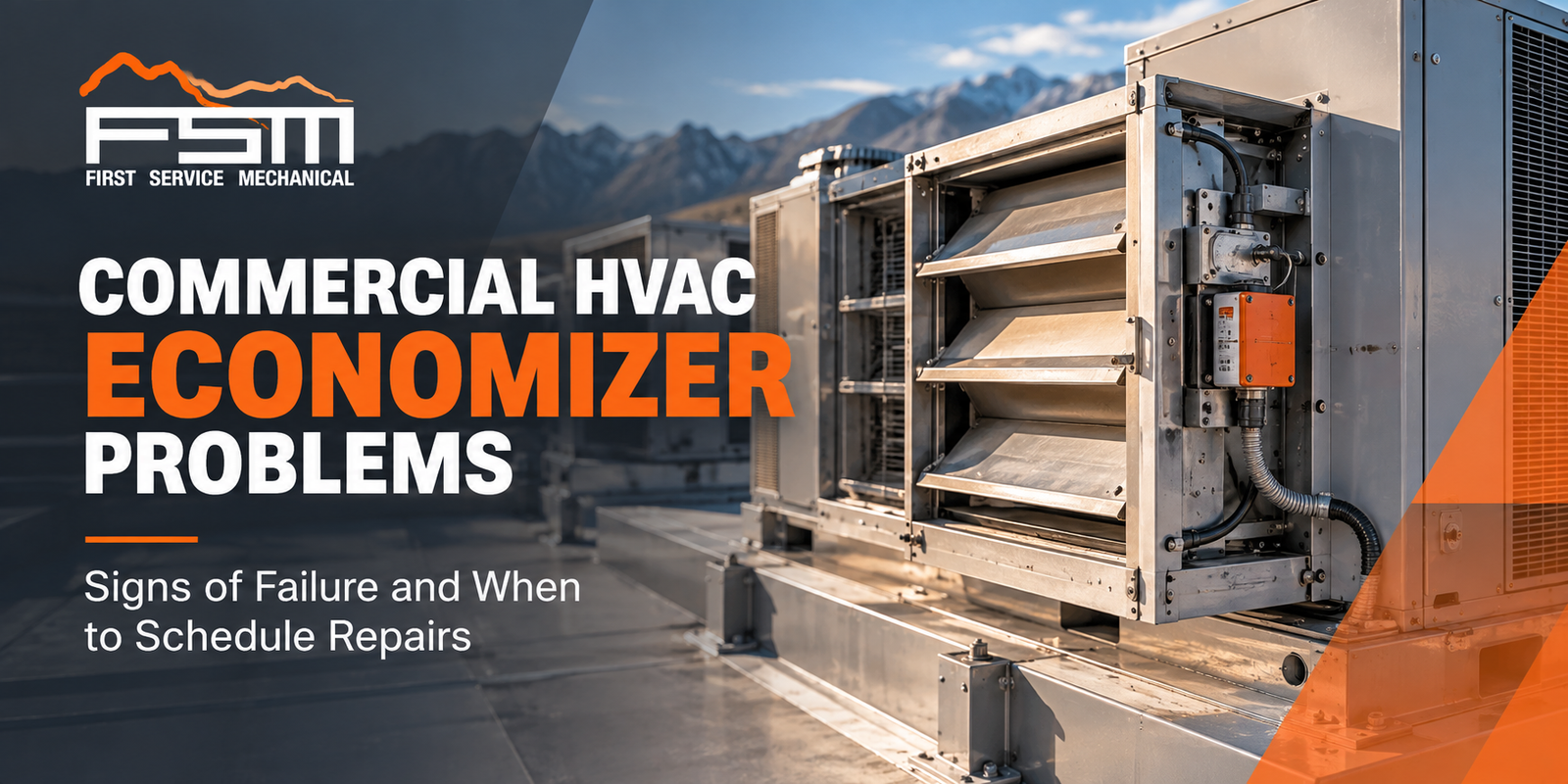
Commercial HVAC systems are responsible for maintaining comfortable indoor temperatures while managing energy consumption throughout a building. However, one component that often goes overlooked is the HVAC economizer.
Economizers are designed to reduce mechanical cooling demand by using outdoor air when conditions are suitable. When functioning properly, they can help commercial facilities lower energy consumption and maintain comfortable indoor conditions. When they malfunction, the result can be unnecessary cooling costs, inconsistent temperatures, and additional strain on HVAC equipment.
For facility managers and building owners, recognizing commercial HVAC economizer problems early can help prevent performance issues from becoming expensive repairs.
Understanding how economizers work, what causes them to fail, and when to schedule professional service is an important part of maintaining an efficient commercial HVAC system.
What Is a Commercial HVAC Economizer?
An HVAC economizer is a system commonly integrated into commercial rooftop units (RTUs) that uses outdoor air to provide cooling when environmental conditions allow.
Instead of relying entirely on mechanical refrigeration, the economizer adjusts outdoor air dampers to introduce cooler outside air into the building.
For example, during mild spring or fall weather, outdoor temperatures may be low enough to help cool a commercial building without requiring continuous compressor operation.
A typical air-side economizer includes several components:
- Outdoor air dampers: Regulate how much outside air enters the HVAC system.
- Damper actuators: Open and close dampers based on control signals.
- Temperature or enthalpy sensors: Determine whether outdoor conditions are suitable for economizer operation.
- HVAC controllers: Coordinate economizer operation with the building’s heating, cooling, and ventilation requirements.
- Relief or exhaust components: Help manage building pressure as outdoor airflow changes.
Because these components work together, a failure in one area can affect the entire economizer’s performance.
First Service Mechanical provides HVAC systems and equipment services for commercial facilities, including rooftop unit service, repairs, and equipment support.
6 Signs Your Commercial HVAC Economizer Isn’t Working Properly
Economizer problems do not always cause a complete HVAC shutdown. In many cases, the system continues operating while gradually becoming less efficient.
Here are six warning signs facility managers should watch for.
1. Increasing Cooling Costs
One of the most noticeable signs of economizer trouble is an unexpected increase in energy consumption.
When outdoor conditions are suitable for free cooling, the economizer should reduce the need for mechanical cooling. If dampers remain closed or sensors provide inaccurate readings, compressors may operate unnecessarily.
If cooling costs increase without a corresponding change in building usage or weather conditions, economizer performance may be worth investigating.
2. Inconsistent Indoor Temperatures
A malfunctioning economizer can introduce too much or too little outdoor air.
For example, dampers stuck open may allow excessive warm air into the system during hot weather. Dampers that fail to open during suitable conditions may prevent the building from benefiting from outdoor air cooling.
These issues can contribute to temperature fluctuations and occupant comfort complaints.
3. Dampers That Remain Open or Closed
Economizer dampers should adjust based on outdoor conditions, ventilation requirements, and cooling demand.
If they become stuck, disconnected, or improperly controlled, airflow may no longer match the building’s needs.
Mechanical wear, actuator failures, and control problems can all prevent dampers from moving correctly.
4. Excessive Compressor Operation
An economizer should reduce compressor operation when outdoor air can provide sufficient cooling.
If compressors continue running during favorable outdoor conditions, the economizer may not be functioning as intended.
However, compressor operation alone does not confirm a malfunction. Cooling loads, humidity requirements, and control sequences must also be considered.
5. Unusual Ventilation or Building Pressure Issues
Economizers affect how outdoor air enters a building.
If outdoor air dampers and relief systems are not operating together correctly, facilities may experience ventilation or pressure problems.
These issues can become particularly noticeable in buildings with significant exhaust requirements or changing occupancy levels.
6. Economizer Faults or Control Alarms
Modern HVAC systems may generate fault codes when economizer components fail to respond correctly.
These alarms can indicate sensor failures, actuator problems, communication issues, or incorrect control sequences.
Facility managers should review recurring alarms rather than repeatedly clearing them without identifying the underlying problem.
What Causes Commercial HVAC Economizer Failure?
Several mechanical and control-related issues can affect economizer operation.
Faulty sensors: Temperature and enthalpy sensors may become inaccurate over time, causing the system to make incorrect decisions about outdoor air cooling.
Damaged actuators: Actuators can fail mechanically or electrically, preventing dampers from reaching their commanded positions.
Stuck or damaged dampers: Dirt, corrosion, worn linkages, and mechanical damage can restrict damper movement.
Incorrect control programming: Improper setpoints, outdated sequences, or manual overrides may prevent economizers from operating efficiently.
Deferred maintenance: Without periodic inspection and testing, small economizer problems may remain undetected.
Because many economizer failures involve controls, professional HVAC controls and system optimization can help identify whether the problem involves mechanical components, sensors, or system programming.
For more information about the importance of control performance, read How Commercial HVAC Controls Improve Efficiency, Comfort, and Equipment Life.
How Economizer Problems Affect Building Energy Efficiency
Economizers are intended to reduce cooling energy consumption, but malfunctioning components can produce the opposite result.
A damper that remains closed may prevent the building from taking advantage of favorable outdoor temperatures.
A damper stuck open may introduce excessive outdoor air during periods of extreme heat or cold, increasing the energy required to maintain indoor conditions.
Improper economizer operation can also affect humidity control, ventilation performance, and equipment runtime.
Over time, these issues may contribute to higher operating expenses and unnecessary wear on HVAC components.
Addressing economizer problems is therefore about more than restoring a single piece of equipment. It helps ensure the broader HVAC system operates according to the building’s actual requirements.
Can Preventative Maintenance Prevent Economizer Failure?
Routine maintenance cannot eliminate every equipment failure, but it can help identify developing economizer problems before they significantly affect performance.
A professional economizer inspection may include:
- Checking outdoor air dampers for proper movement
- Testing damper actuators and linkages
- Verifying temperature and enthalpy sensor readings
- Reviewing economizer control sequences
- Checking minimum outdoor air settings
- Testing operation under appropriate simulated conditions
- Reviewing fault codes and operating trends
These evaluations are particularly valuable before seasonal changes, when outdoor temperatures may create more opportunities for economizer operation.
First Service Mechanical offers HVAC and refrigeration maintenance services designed to support equipment reliability and identify developing performance concerns.
Facility managers can also reference FSM’s Commercial HVAC and Refrigeration Maintenance Checklist for additional maintenance considerations.
When Should You Schedule Commercial Economizer Repairs?
Facility managers should consider professional economizer service when they notice unexplained cooling costs, recurring control alarms, temperature inconsistencies, or dampers that do not respond correctly.
An evaluation is also worthwhile after rooftop unit replacements, control upgrades, or building renovations that may affect HVAC operation.
Not every economizer issue requires replacing the entire assembly. Depending on the problem, repairs may involve sensors, actuators, damper mechanisms, or control adjustments.
A professional assessment can help determine whether targeted repairs are appropriate or whether more extensive equipment improvements are necessary.
Commercial HVAC Economizer Repair in Salt Lake City
Commercial buildings throughout Salt Lake City and Utah’s Wasatch Front experience significant seasonal temperature changes. Proper economizer operation can help facilities take advantage of suitable outdoor conditions while maintaining reliable indoor comfort.
First Service Mechanical provides commercial HVAC services for facilities that depend on efficient, reliable mechanical systems.
From rooftop equipment repairs and preventative maintenance to HVAC controls and system optimization, FSM helps building owners and facility managers address performance problems and support long-term equipment reliability.
If your building is experiencing economizer problems, unexpected cooling costs, or inconsistent HVAC performance, contact First Service Mechanical to discuss a professional system evaluation.
Identifying economizer issues early can help restore proper operation, reduce unnecessary energy consumption, and keep your commercial HVAC system performing as intended.

Leave a Reply