


For many businesses, HVAC equipment is one of the largest investments in their facility. Yet replacement planning often doesn’t happen until a rooftop unit fails, a boiler stops operating, or an aging chiller can no longer keep up with demand. While emergency replacements may seem unavoidable, they often result from a lack of long-term planning rather than unexpected equipment failure.
HVAC equipment lifecycle planning enables building owners and facility managers to anticipate future needs, budget with confidence, and make informed decisions before costly breakdowns occur. Instead of reacting to emergencies, organizations can proactively manage their mechanical systems to reduce financial risk, improve reliability, and maximize the value of their existing equipment.
What Is HVAC Equipment Lifecycle Planning?
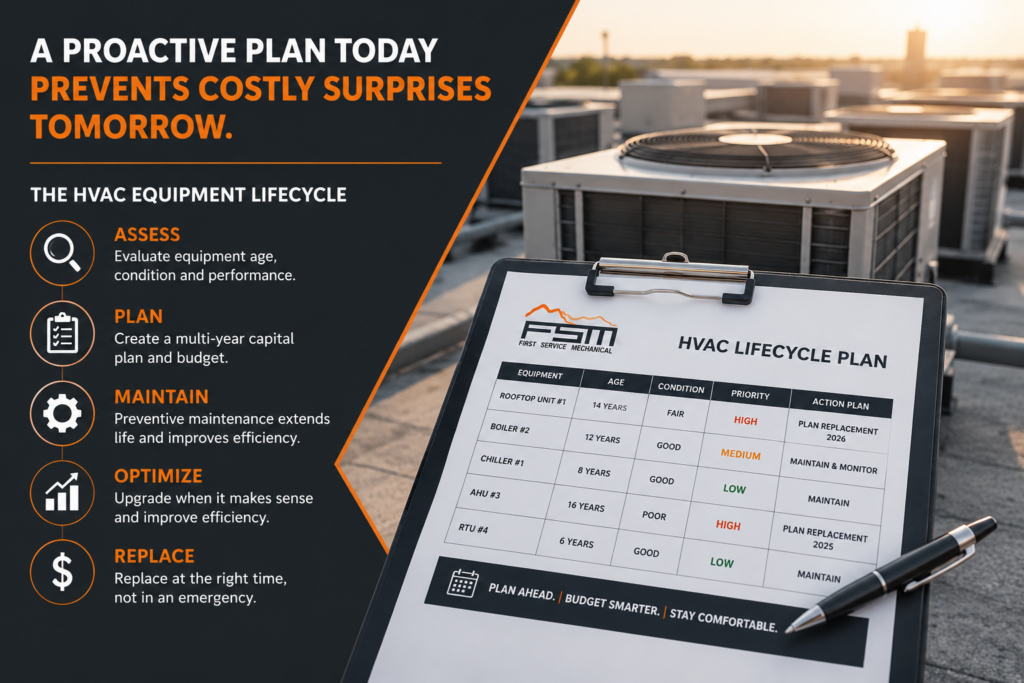
HVAC equipment lifecycle planning is the process of evaluating the age, condition, performance, and expected lifespan of mechanical systems to create a long-term replacement and maintenance strategy.
Rather than assuming equipment will operate until it fails, lifecycle planning helps answer important questions such as:
- Which systems are nearing the end of their useful life?
- Which assets still have several years of reliable service remaining?
- What replacements should be budgeted over the next five to ten years?
- Which upgrades could improve efficiency and lower operating costs?
By understanding where each piece of equipment is in its lifecycle, businesses can prioritize investments rather than be caught off guard by unexpected failures.
The Cost of Waiting Until Equipment Fails
Emergency HVAC replacements are almost always more expensive than planned projects.
When a critical system fails unexpectedly, businesses often face additional costs beyond the equipment itself, including:
- Emergency service calls
- Temporary cooling or heating solutions
- Overtime labor
- Rush equipment orders
- Business interruptions
- Tenant or occupant complaints
- Reduced employee productivity
In many commercial environments, HVAC downtime can impact much more than comfort. Office buildings, manufacturing facilities, healthcare environments, retail spaces, schools, and warehouses all rely on dependable climate control to maintain daily operations.
Planning helps eliminate many of these avoidable costs.
Age Isn’t the Only Factor
While equipment age is important, it shouldn’t be the only factor used when determining whether replacement is necessary.
Several variables influence how long commercial HVAC equipment will continue operating efficiently, including:
Maintenance History
Equipment that receives regular preventive maintenance generally performs better and lasts longer than systems that are serviced only after problems occur.
Operating Conditions
Systems that run continuously or operate in harsh environments often experience greater wear than equipment serving lighter-duty applications.
Repair Frequency
A unit requiring multiple repairs each year may cost more to maintain than it would to replace.
Energy Performance
Older equipment frequently consumes more energy than newer, high-efficiency systems. Even if it still operates, rising utility costs may justify upgrading sooner.
Availability of Replacement Parts
As equipment ages, replacement parts can become difficult—or impossible—to source, increasing repair costs and downtime.
Looking at all of these factors together provides a much more accurate picture than relying on equipment age alone.
The Value of a Professional HVAC Assessment
One of the most effective ways to begin lifecycle planning is with a comprehensive HVAC assessment.
An assessment provides valuable insight into the condition and performance of your mechanical systems, allowing facility managers to make data-driven decisions instead of relying on assumptions.
A professional assessment typically evaluates:
- Equipment age and remaining expected service life
- Overall mechanical condition
- Operational efficiency
- Maintenance history
- Existing performance issues
- Safety concerns
- Opportunities for energy savings
- Recommended repair or replacement timelines
Rather than recommending immediate replacement across the board, a quality assessment identifies where investments will deliver the greatest value over time.
Creating a Multi-Year Capital Plan
One of the biggest advantages of lifecycle planning is the ability to spread capital expenses across multiple budget cycles.
Instead of replacing several major systems during the same year, businesses can prioritize equipment based on condition, risk, and operational importance.
For example:
- Replace one aging rooftop unit this year.
- Upgrade an outdated building control component next year.
- Plan for boiler replacement in three years.
- Budget for a chiller modernization five years from now.
This staged approach allows organizations to better manage cash flow while reducing the likelihood of multiple unexpected failures occurring at once.
Improving Energy Efficiency Along the Way
Lifecycle planning isn’t only about replacing aging equipment—it’s also an opportunity to improve building performance.
Today’s commercial HVAC systems offer significant advancements in:
- Energy efficiency
- Variable-speed technology
- Smart controls
- Building automation integration
- Indoor comfort
- System monitoring
Replacing equipment at the right time can reduce utility costs while improving occupant comfort and system reliability.
In many cases, businesses discover that lower operating costs help offset a portion of the investment over the equipment’s lifespan.
Preventive Maintenance Supports Longer Equipment Life
Even the best replacement strategy depends on consistent preventive maintenance.
Routine inspections, cleaning, testing, and adjustments help identify small issues before they become expensive failures.
Preventive maintenance also provides valuable performance data that supports better lifecycle planning by identifying:
- Components are wearing faster than expected
- Declining system efficiency
- Refrigerant issues
- Airflow problems
- Developing mechanical concerns
The more information facility managers have about system performance, the easier it becomes to forecast future replacement needs accurately.
Maintenance and lifecycle planning work together—not as separate strategies, but as complementary parts of a proactive facility management program.
Building a Strategy That Fits Your Business
Every commercial property has different operational priorities, occupancy schedules, equipment types, and budget constraints.
A healthcare facility may prioritize redundancy and uninterrupted operation. A manufacturing plant may focus on production uptime. An office building may emphasize occupant comfort and energy efficiency.
That’s why HVAC lifecycle planning should never rely on a one-size-fits-all approach.
Instead, businesses benefit from a customized strategy that considers:
- Building age
- Mechanical system condition
- Business operations
- Budget goals
- Future growth plans
- Energy objectives
- Facility priorities
This allows organizations to make informed decisions that balance operational reliability with responsible financial planning.
Partner With First Service Mechanical for Long-Term HVAC Planning
Unexpected HVAC failures don’t have to dictate your capital budget. With proactive lifecycle planning, businesses can gain greater visibility into the condition of their mechanical systems, prioritize investments, and reduce the risk of costly emergency replacements.
At First Service Mechanical, we help commercial building owners, facility managers, and property managers evaluate their HVAC infrastructure through comprehensive assessments, preventive maintenance programs, and long-term planning strategies. Our experienced team works alongside your organization to identify opportunities for improved reliability, greater efficiency, and smarter capital planning so you can make confident decisions well before equipment reaches the end of its service life.
Whether you’re managing a single commercial building or a portfolio of facilities, investing in HVAC equipment lifecycle planning today can help you avoid unexpected expenses tomorrow. Contact us to get started!

Leave a Reply